Solar Cell Characteristics Apparatus
Product Code : SCL-EAE-11298
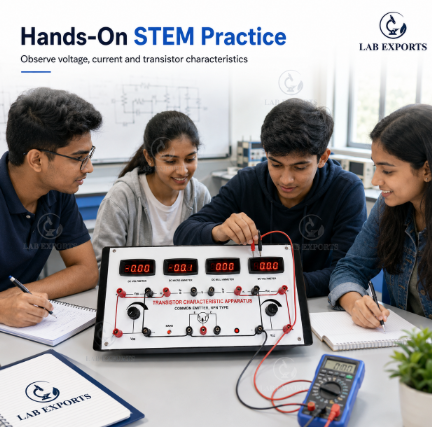
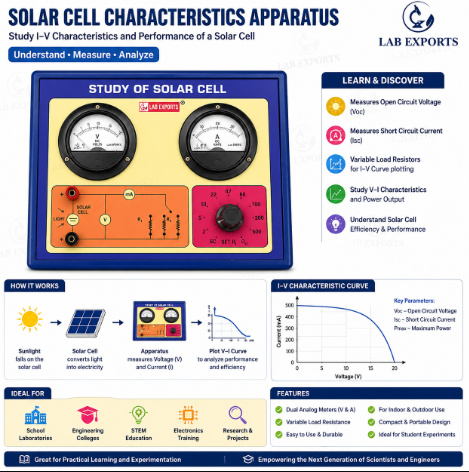
This trainer is used to plot the current-voltage (I-V) curve of a solar cell. The cell is lit, a variable load is stepped from open circuit towards short circuit, and the output voltage and current are read at each point. The readings give the open-circuit voltage, the short-circuit current and the maximum power point.
Specifications of the solar cell characteristics apparatus
| Component | Specification |
|---|---|
| Apparatus type | Educational photovoltaic-characteristics trainer |
| Measured quantities | Solar-cell output voltage and current |
| Main experiment | Plotting the current-voltage characteristic of a solar cell |
| Load | Variable load for many operating points |
| Layout | Instructional layout that makes the measurement circuit easy to follow |
| Meter ranges, cell type and illumination arrangement | Confirmed with the quotation |
| House code | SCL-EAE-11298 |
| Manufacturer | Lab Exports, Delhi |
Experiments on the photovoltaic trainer
A solar cell is a p-n junction that gives a current when it absorbs light. With no load it shows its open-circuit voltage Voc. With its terminals shorted it gives the short-circuit current Isc. Each load value between these limits gives one operating point on the curve.
- I-V and power curves. Light the cell evenly and record Voc with no load current. Step the load down to the short-circuit condition, reading V and I each time. Plot I against V, then work out P = V × I at each point to find the maximum power Pmax. The fill factor is Pmax/(Voc × Isc).
- Effect of light intensity. Repeat the run with the light weaker or stronger. Isc rises with illumination, while Voc changes much less.
- More points near the knee. For finer steps where the curve bends, use a 7 decade resistance box as the load, and check the readings with a digital multimeter.
Recording the I-V readings
- Put the apparatus on a steady, dry bench. Connect the solar cell, meters and variable load as marked.
- Set the load control to its recommended starting position.
- Direct a suitable light source evenly onto the cell surface.
- Record the open-circuit voltage, then adjust the load in small steps, noting voltage and current each time.
Frequently Asked Questions
Which light source is used for a solar cell characteristics experiment?
A steady lamp or direct sunlight. A lamp is easier to hold constant, so keep it at a fixed distance for a whole run, as the readings change with intensity. The illumination arrangement for this trainer is confirmed with the quotation.
What kind of load is used to trace the I-V curve?
A variable resistance that can be stepped from open circuit to short circuit. This trainer has its own variable load for that. Its steps should be fine enough to give several readings near the knee of the curve.
What is the fill factor of a solar cell?
It is the ratio of the maximum power to the product Voc × Isc. It always lies between 0 and 1, and it shows how square the I-V curve is. A squarer curve means the cell gives out power closer to that ideal product.
Why is the I-V curve of an illuminated solar cell plotted in the fourth quadrant?
Under light the cell acts as a source. Its current flows opposite to the forward current of a diode while the voltage stays positive, so the curve falls in the fourth quadrant. Many lab manuals flip the current axis and plot it in the first.
How do series and shunt resistance affect the fill factor?
High series resistance tilts the vertical part of the curve, and low shunt resistance tilts the flat part. Both round off the knee and lower the fill factor, so the cell gives out less power.
Other characteristic-curve apparatus
More apparatus is in the Electrical and Electronics section of the Physics Lab range.
To enquire, email [email protected] with the house code SCL-EAE-11298 and the quantity, or use the Add To Cart button on this page.
Last updated: 23 November 2026