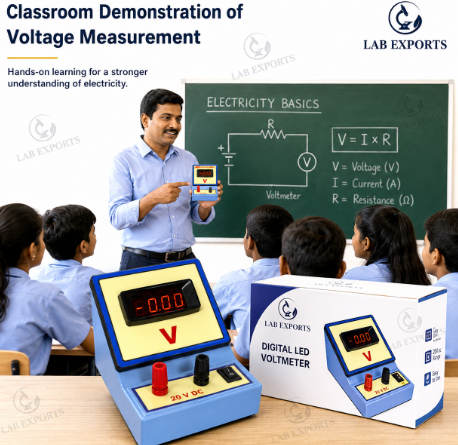
Digital LED Voltmeter
Product Code : SCL-EAE-11353
This digital LED voltmeter shows potential difference as bright illuminated digits that a whole class can read from the front of the room. It is joined in parallel, across the supply or the component under study. Students use it to compare the supply voltage with the voltage drops across lamps and resistors.
Specifications of the digital LED voltmeter
| Component | Specification |
|---|---|
| Instrument | Digital potential difference meter |
| Display | Illuminated LED digital readout |
| Connection | In parallel across the component or supply |
| Range, AC or DC capability, resolution and power | Given in the quotation for the model supplied |
| House code | SCL-EAE-11353 |
| Manufacturer | Lab Exports, Delhi |
Class demonstrations of potential difference
Check the voltage type and maximum range shown on the instrument first. Switch the circuit off, join the leads across the part to be studied with the positive lead on the higher-potential side, then switch on and read. The leads can be moved from part to part without breaking the circuit.
- Drops in a series chain. Run three resistors from an IC Regulated Power Supply. Read the supply voltage, then the voltage across each resistor. The drops add up to the supply voltage.
- Equal voltage in parallel. Join two resistance coils in parallel across the same supply. The meter gives the same reading across each branch, whatever its resistance.
- Terminal voltage of a cell. Read across a Leclanche cell on open circuit, then while it drives current through a rheostat. The reading drops under load, which opens a lesson on internal resistance.
Frequently Asked Questions
Which is better, an LED display or an LCD display?
It depends on where the meter is used. An LED display makes its own light, so it is easy to read in a dim room, from the side or from a distance, which suits demonstrations. An LCD without a backlight needs outside light, but it uses very little power.
Which consumes less power, LED or LCD?
An LCD without a backlight uses less, because it only blocks or passes light that is already there. An LED display lights every segment it shows, so it draws more current. The power requirement of this LED voltmeter is stated in the quotation.
How is a voltmeter connected to measure potential difference?
In parallel, with one lead on each side of the component or supply. The circuit is not broken. The positive lead goes to the side at higher potential, and the meter shows the difference between the two points.
What is 1 volt of potential difference?
It is the potential difference between two points when one joule of energy is transferred for each coulomb of charge that moves between them. So a voltmeter reading tells you the energy given to or taken from each unit of charge.
How does voltage behave across resistors in series?
The supply voltage is shared among them. The same current flows through each resistor, so each drop is that current times its resistance. The larger resistor takes the larger share, and all the drops add up to the supply voltage.
Other apparatus for potential difference practicals
More apparatus is in the Electrical and Electronics section of the Physics Lab range.
To enquire, email [email protected] with the house code SCL-EAE-11353 and the quantity, or use the Add To Cart button on this page.
Last updated: 23 November 2026