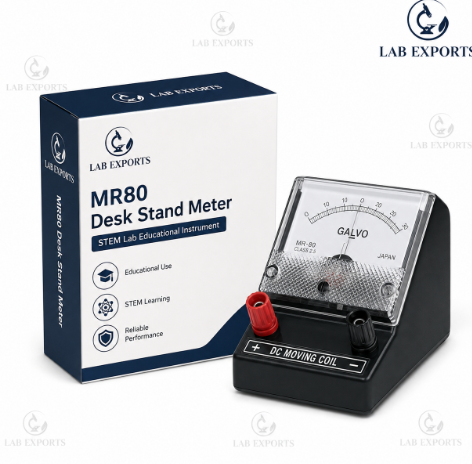
MO65 Desk Stand Meter
Product Code : SCL-EAE-11358
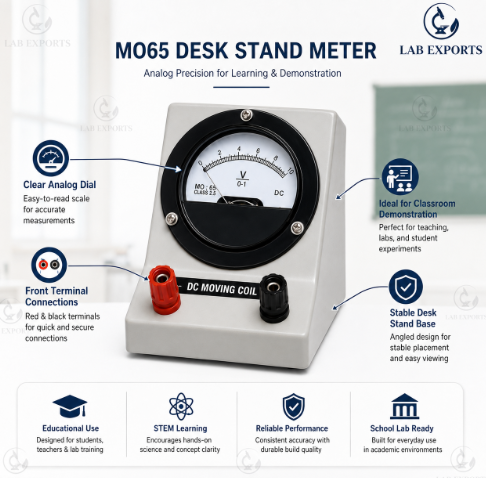
The MO65 is an analog pointer meter on a desk stand, with a graduated scale and front connection terminals. The desk-stand format places the dial where it is easy to observe. Its measuring function, calibrated range, accuracy class and AC or DC rating are specified when ordering, so the buyer states what each practical needs.
Specifications of the MO65 desk stand meter
| Component | Specification |
|---|---|
| Display | Analog pointer with a graduated scale |
| Format | Desk stand |
| Terminals | Front connection terminals |
| Function, range, class and AC or DC rating | Specified when ordering |
| Users | Schools, colleges, technical institutes and physics teachers |
| House code | SCL-EAE-11358 |
| Manufacturer | Lab Exports, Delhi |
Circuit work with an MO65 at the bench
Confirm the measuring function, range and AC or DC rating of the meter before wiring. Switch the circuit off to connect it, and observe polarity.
- Series and parallel combinations. Feed a Resistance in Series and Parallel Apparatus from an IC Regulated Battery Eliminator. An MO65 ordered as an ammeter goes in series with the supply. Rewire the resistors from series to parallel and watch the pointer rise as the total resistance falls.
- A matched pair. Order one MO65 as a voltmeter and one as an ammeter, with ranges that suit the circuit. Set a value on a Resistance Box 100 Ohms and step the current with a rheostat. Both meters are read at each setting, and V against I gives a straight line.
Frequently Asked Questions
What should be decided when choosing an analog meter?
Start with the function, meaning the quantity the meter will measure. Then fix the range, AC or DC, the accuracy class, and a size and style that suit the bench. For the MO65, state the function, range, class and AC or DC rating when you enquire.
What are the types of analog meters?
The common types are ammeters and voltmeters, with galvanometers for very small currents, and ohmmeters and frequency meters for other quantities. The MO65 is a desk stand pointer meter, and its measuring function is set when it is ordered.
Why does an ammeter go in series but a voltmeter in parallel?
An ammeter must carry the same current as the part it measures, so it sits in series, and its resistance is very low. A voltmeter compares two points, so it goes across the part and has a high resistance. Wired the other way round, the readings are wrong and an ammeter can be damaged.
What is the loading effect of a voltmeter?
It is the change a voltmeter makes in the circuit it measures. The meter draws a small current, so across a high resistance it lowers the very voltage it is reading. A voltmeter with a higher resistance, or ohms-per-volt figure, loads the circuit less.
More meters for circuit practicals
More apparatus is in the Electrical and Electronics section of the Physics Lab range.
To enquire, email [email protected] with the house code SCL-EAE-11358 and the quantity, or use the Add To Cart button on this page. Tender buyers can also see the Tenders and OEM page.
Last updated: 23 November 2026