Ballistic Galvanometer
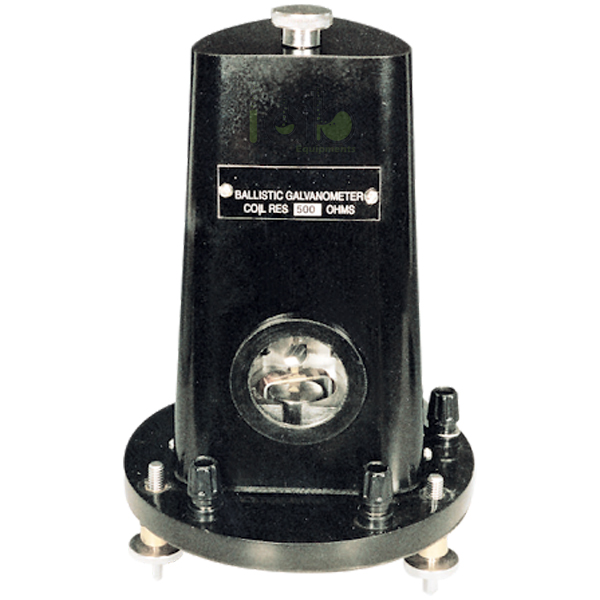
Product Code : EL-LM-10391
This ballistic galvanometer measures small quantities of charge, and also very low currents. Its long 12 s period lets a short pulse of charge pass before the coil has moved much, so the first throw follows the charge. It is made in 100 Ω and 500 Ω versions, with a mirror-suspended coil in a Bakelite case.
Specifications of the ballistic galvanometer
| Component | Specification |
|---|---|
| Coil resistance | 100 Ω or 500 Ω (two versions) |
| Time period | 12 s, both versions |
| Charge sensitivity | 300 mm/µC (100 Ω); 600 mm/µC (500 Ω) |
| Current sensitivity | 1000 mm/µA (100 Ω); 1400 mm/µA (500 Ω) |
| Critical damping resistance | 2000 Ω (100 Ω); 3500 Ω (500 Ω) |
| Movement | Mirror-suspended coil on a long upper suspension and a lower spring, both of a special alloy |
| Levelling | Levelling screws for balancing the coil |
| Case | Bakelite |
| House code | EL-LM-10391 |
| Manufacturer | Lab Exports, Delhi |
Charge measurements with the ballistic galvanometer
Level the instrument with its levelling screws so the coil hangs freely, and set a lamp and scale in front of the mirror. The first throw θ is proportional to the charge Q that passed: Q = Kθ, where K is the ballistic constant of the galvanometer.
- Comparison of two capacitances. Charge each capacitor in turn from the same Leclanche cell, then discharge it through the galvanometer by changing over a Two Way Plug Key. For the same charging voltage, C1/C2 = θ1/θ2, where θ1 and θ2 are the first throws.
- Bringing the coil to rest. After each throw, close a Tapping Key joined across the galvanometer terminals. The short-circuited coil is strongly damped and settles quickly, ready for the next reading.
- Flux through a search coil. Join a search coil to the galvanometer and pull it quickly away from a pole of an Electromagnet. The first throw is proportional to the change of magnetic flux through the coil.
Frequently Asked Questions
What is the current sensitivity of a ballistic galvanometer?
It is the deflection for each microampere of steady current through the coil. A high figure lets the galvanometer show very low currents as well as charge. This one gives 1000 mm/µA in the 100 Ω version and 1400 mm/µA in the 500 Ω version.
Does a ballistic galvanometer need a lamp and scale?
Yes. The throw is read from a beam of light reflected by the mirror on the coil onto a scale in front of the instrument. Set the lamp and scale up before the experiment, at a fixed distance, so that all throws are read in the same way.
Why is the critical damping resistance given for a ballistic galvanometer?
Because the damping of the coil depends on the resistance of the circuit joined to it. The critical value is the external resistance at which the coil just returns to zero without swinging past it. Less resistance damps the coil more and cuts the first throw. It is 2000 Ω for the 100 Ω version and 3500 Ω for the 500 Ω version.
How does a ballistic galvanometer differ from an ordinary galvanometer?
An ordinary galvanometer gives a steady deflection proportional to a steady current. A ballistic galvanometer measures a pulse of charge, and its first throw is proportional to that charge. It needs a long period, 12 s on this instrument, so the pulse ends before the coil moves far.
What is the ballistic constant of a galvanometer?
It is the charge that gives one unit of first throw, K = Q/θ. It is found by discharging a capacitor of known capacitance, charged to a known voltage, through the galvanometer. Once K is known, any other throw gives the charge directly.
Keys, sources and resistances for charge work
- One Way Plug Key
- Battery Eliminator, as a steady charging source
- Resistance Box Plug Type, for setting the circuit resistance
More apparatus is in the Lab Meters section of the Physics Lab range.
To enquire, email [email protected] with the house code EL-LM-10391 and the quantity, or use the Add To Cart button on this page. Tender buyers can also see the Tenders and OEM page.
Last updated: 24 November 2026