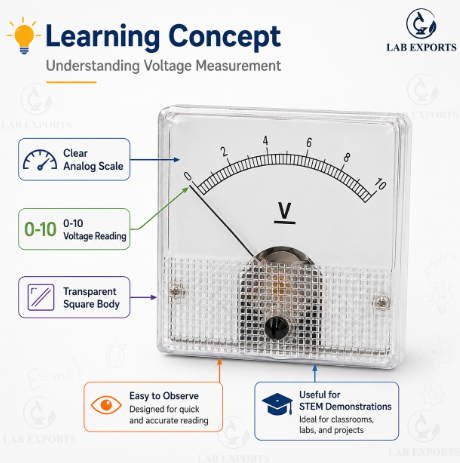
Demonstration Meter Interscale

Product Code : EL-LM-10389
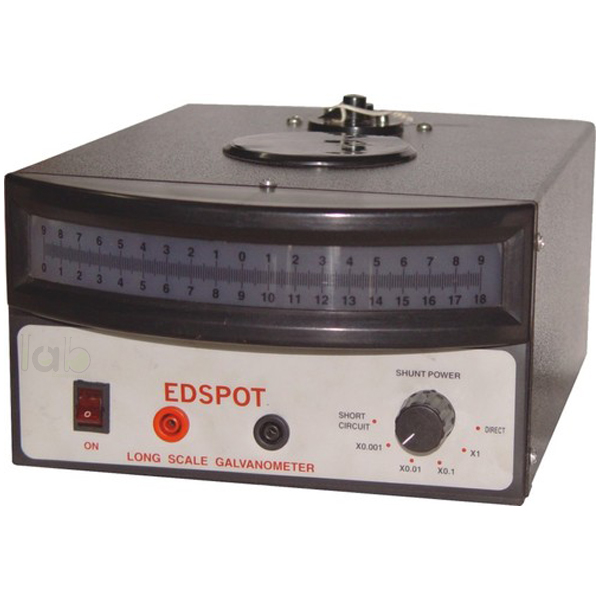
This interscale demonstration meter is a large classroom meter for showing readings and the principles of electrical measurement to a whole class. Its scale is about 200 mm long. The basic movement gives full-scale deflection at 5 mA and 100 mV, with an accuracy of ±2.5% of full-scale deflection.
Specifications of the interscale demonstration meter
| Component | Specification |
|---|---|
| Basic movement | 5 mA - 100 mV full-scale deflection (FSD) |
| Accuracy | ±2.5% FSD |
| Scale length | About 200 mm |
| Dimensions | 300 x 150 x 300 mm |
| Weight | About 2 kg |
| House code | EL-LM-10389 |
| Manufacturer | Lab Exports, Delhi |
Whole-class work on the 200 mm scale
- A shared reference reading. Build a circuit at the demonstration bench with a Battery Eliminator and a rheostat, with the meter in it. Change the rheostat in steps. Every student records the same readings from the large scale, so the class works from one data set.
- Reading to the stated accuracy. An error of 2.5% of full scale is the same size at every point on the scale. It is therefore a larger share of a small reading. Ask students why a reading near the top of the scale can be trusted more than one near zero.
Frequently Asked Questions
What is an interscale demonstration meter?
It is a large demonstration meter built around one sensitive moving-coil movement. Interscales are scale plates for that movement, and each one works with the shunt or series resistance that suits its range. On this meter the basic movement is 5 mA - 100 mV FSD, behind a scale of about 200 mm.
What accuracy is suitable for a classroom demonstration meter?
About ±2.5% of full-scale deflection is usual, and it is enough for demonstrations in front of a class. This meter is rated at ±2.5% FSD. Close numerical work, such as finding a resistance to several figures, is better done on bench meters.
Why is the full scale deflection of a galvanometer needed when it is used as a voltmeter?
Because the series resistance is chosen from it. The full voltage of the new range must drive exactly the full-scale current Ig through the movement. So the series resistance R = V/Ig - G, where V is the range and G is the movement resistance.
Items for circuits at the demonstration bench
More apparatus is in the Lab Meters section of the Physics Lab range.
To enquire, email [email protected] with the house code EL-LM-10389 and the quantity, or use the Add To Cart button on this page.
Last updated: 24 November 2026