Basic Meter
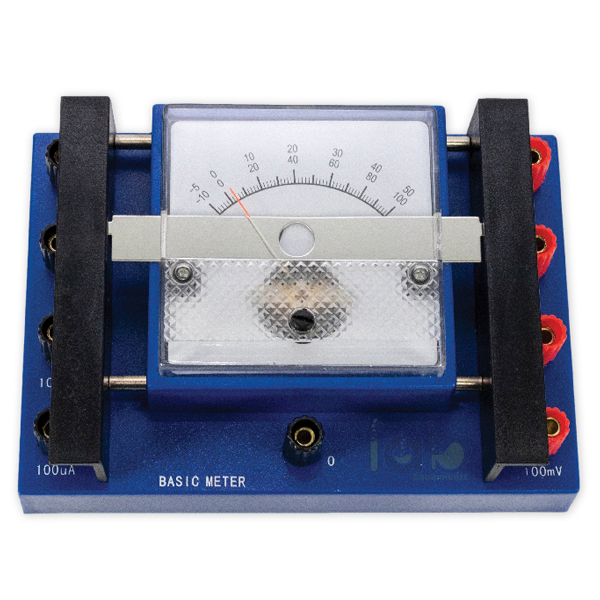
Product Code : EL-LM-10392
This basic meter is a dual-purpose teaching instrument that works either as an ammeter or as a voltmeter. The quantity is chosen by sliding the scale. It reads currents from 100 µA to 5 A and voltages from 100 mV to 50 V, and a guide for the teacher is supplied with it.
Specifications of the basic meter
| Component | Specification |
|---|---|
| Function | Ammeter or voltmeter, chosen by sliding the scale |
| Current range | 100 µA to 5 A |
| Voltage range | 100 mV to 50 V |
| Supplied with | Guide for the teacher |
| House code | EL-LM-10392 |
| Manufacturer | Lab Exports, Delhi |
Circuit lessons with one meter for current and voltage
Slide the scale before the meter goes into the circuit, and check it again each time the job changes. Start on the highest range and work down until the reading is clear.
- Current first, then voltage. Build a circuit from a Battery Eliminator, a Resistance Coil and a One Way Plug Key. With the scale set for current, break the circuit and put the meter in series. Then slide the scale to voltage and join the meter across the coil instead.
- Series or parallel on one supply. Set the meter for current and put it in the supply lead of the Lamps in Series Kit. Read the current, then put the meter in the supply lead of the Lamps in Parallel Kit, run from the same low-voltage supply. The parallel kit draws far more current, because every lamp is joined straight across the supply and the total resistance is much lower.
Documentation and supply
A teacher's guide is supplied with the meter. Most Lab Exports products carry a one-year manufacturer warranty.
Lab Exports manufactures the Basic Meter at its works in Laxmi Nagar, Delhi, and supplies it to schools, colleges and universities in India and 60+ countries, handling the export documents for each shipment. More about the company is on the About Lab Exports page.
Frequently Asked Questions
How can one meter work as both an ammeter and a voltmeter?
Both can use the same sensitive moving coil. For current, a low resistance in parallel carries most of the current. For voltage, a high resistance in series limits the current through the coil. On this basic meter, sliding the scale selects ammeter or voltmeter use.
What should be checked in a combined ammeter and voltmeter for a classroom?
Check that the current and voltage ranges cover the circuits in your syllabus, and that everything needed for both uses comes with the meter. This basic meter covers 100 µA to 5 A and 100 mV to 50 V, and a guide for the teacher is supplied.
What happens if you connect a voltmeter in series?
Very little current flows, because the resistance of a voltmeter is very high. Lamps and other parts in the circuit stop working, and the meter reads nearly the whole supply voltage. The meter is not usually harmed, but the reading means nothing for the part under test.
What will happen if ammeter and voltmeter interchange?
The voltmeter, now in series, cuts the current almost to zero. The ammeter, now across the part, carries most of that small current. Neither reading is correct. With a single meter set for current but joined across a supply, a heavy current can damage it.
Apparatus for series and parallel circuit lessons
More apparatus is in the Lab Meters section of the Physics Lab range.
To enquire, email [email protected] with the house code EL-LM-10392 and the quantity, or use the Add To Cart button on this page. Tender buyers can also see the Tenders and OEM page.
Last updated: 24 November 2026