Analog Frequency Meter
Product Code : SCL-LM-11129
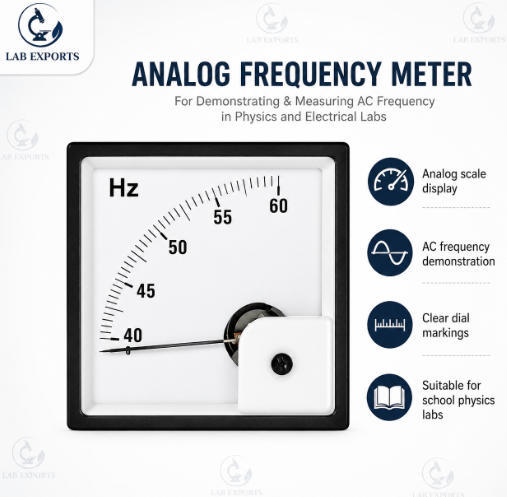
This analog frequency meter shows the frequency of an alternating-current supply in hertz, read from a pointer on a graduated scale. It is connected across the supply, in parallel, like a voltmeter. In electricity lessons it turns the idea of cycles per second, and the relation f = 1/T, into a reading students can see.
Specifications of the analog frequency meter
| Component | Specification |
|---|---|
| Instrument type | Analog frequency meter |
| Measured quantity | Electrical frequency of an AC supply |
| Unit | Hertz (Hz), cycles per second |
| Display | Graduated analog scale, read by the pointer |
| Connection | Across the supply, in parallel |
| House code | SCL-LM-11129 |
| Manufacturer | Lab Exports, Delhi |
AC frequency lessons with the meter
The frequency f is the number of complete cycles each second, and the period T of one cycle is 1/f. The teacher connects the meter across a supply that lies within the range marked on its scale.
- Sonometer cross-check. Students find the frequency of the AC supply by resonance with a sonometer driven from a step-down transformer. Compare their result with the meter reading on the supply that feeds the transformer.
- Voltage changes, frequency does not. Use the Demountable Transformer to explain that a transformer changes voltage but not frequency. If the meter is rated for the secondary voltage as well, read the frequency on both sides and compare.
- Period on an oscilloscope. Display the same supply on a cathode ray oscilloscope, measure the period T of one cycle and check that 1/T agrees with the meter reading.
Frequently Asked Questions
What are the main types of analog frequency meters?
The common types are the vibrating-reed meter, the electrodynamic or ratio meter, and the moving-coil meter fed through a converter circuit. Reed meters show the frequency in steps by tuned reeds, while pointer types give a continuous reading across a band. This meter is read by a pointer on a graduated scale.
How do you choose an analog frequency meter?
Match the scale range to the nominal frequency of the supply, check the rated input voltage and confirm the mounting or panel size. Look at the accuracy class and how clearly the scale reads. For this meter, state the supply to be measured when enquiring, so the range and connection suit it.
What is the working principle of a frequency meter?
It uses a part whose response depends on frequency. In a reed meter, the reed marked with the frequency nearest to that of the supply vibrates most, by resonance. Pointer meters use coil circuits whose currents change with frequency, so the pointer settles at a position marked in hertz.
How can the frequency of an AC supply be found?
Read it directly on a frequency meter connected across the supply. Or display the wave on an oscilloscope, measure the period T of one cycle and use f = 1/T. In the physics lab, students also find it by resonance with a sonometer wire.
Other apparatus for AC electricity lessons
More apparatus is in the Lab Meters section of the Physics Lab range.
To enquire, email [email protected] with the house code SCL-LM-11129 and the quantity, or use the Add To Cart button on this page.
Last updated: 24 November 2026