Analog Voltmeter Panel Type
Product Code : SCL-LM-11152
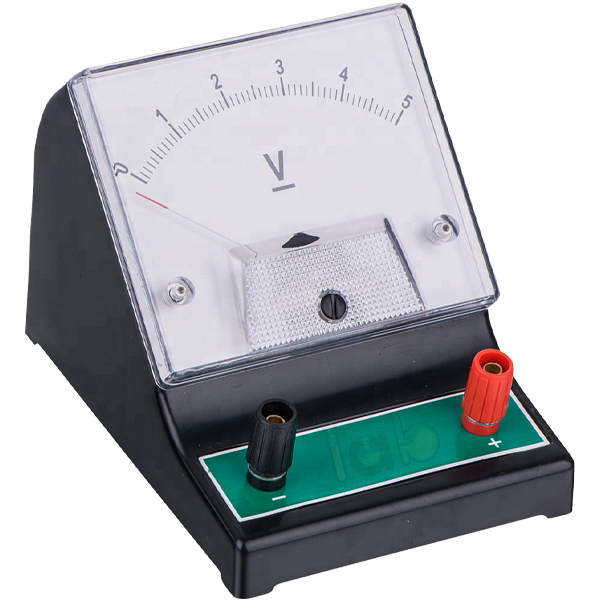
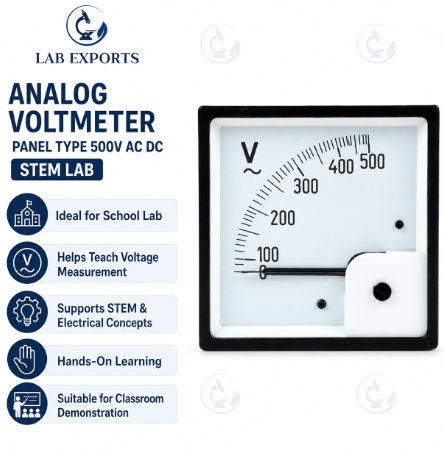
This analog voltmeter, panel type, is set into the face of a teaching panel, power supply board or trainer kit and shows potential difference on an analog scale. It is wired in parallel, across whatever supply or component is being watched. The meter stays in view beside the controls, so a voltage can be set or followed while the circuit runs.
Specifications of the panel voltmeter
| Component | Specification |
|---|---|
| Instrument type | Panel-mounted analog voltmeter |
| Measured quantity | Potential difference (voltage) |
| Display | Pointer on an analog scale |
| Fitting | Built into teaching panels, power supply boards and trainer kits |
| Connection | In parallel, across the part measured |
| House code | SCL-LM-11152 |
| Manufacturer | Lab Exports, Delhi |
Voltage experiments on a panel board
Use a meter rated above the highest voltage on the board, and wire it across the supply or component. The two tasks here assume a DC meter, with its positive terminal on the higher-potential side.
- Set the voltage first. On a trainer board, use a rheostat in its potential divider connection across the DC supply, and fit the panel voltmeter across the output terminals. Turn the slider until the meter shows the voltage the experiment needs, and only then connect the circuit. This habit protects components and meters alike.
- Zener regulation. Let an IC Regulated Power Supply feed a Zener Diode Unit, reverse biased and behind a series resistor, with the panel voltmeter across the diode. Turn the supply up slowly. Past breakdown, the meter reading hardly moves while the supply keeps rising.
Documentation and supply
Most Lab Exports products carry a one-year manufacturer warranty.
Lab Exports manufactures the analog panel voltmeter at its works in Laxmi Nagar, Delhi, and supplies it to schools, colleges and universities in India and 60+ countries, handling the export documents for each shipment. More about the company is on the About Lab Exports page.
Frequently Asked Questions
What should be checked before buying an analog panel voltmeter?
Check whether it is for AC or DC, its full-scale range, the panel cut-out and depth it needs, and its accuracy class. A high input resistance loads the circuit less, and a mirror scale with a zero-adjust screw helps careful reading. Give these needs with the house code when enquiring.
What full-scale range should a panel voltmeter have?
Pick a range a little above the normal working voltage. The pointer then rests well up the dial, where it reads most clearly, and is not driven off the end. Too large a range leaves the pointer low, where small changes are hard to see.
How do you read an analogue voltmeter?
Check the unit and the range on the dial. Find the value of one small division from the numbered marks on either side of it. Read the pointer to the nearest half division, correct any zero error and write the unit.
How is zero error corrected on an analogue meter?
Set the pointer back to zero before connecting, or allow for the error in every reading. Where the meter has a zero-adjust screw, turn it until the pointer sits on zero. If it has none and the pointer rests above zero, subtract that amount from every reading; if below, add it.
Other items for voltage-monitoring boards
More apparatus is in the Lab Meters section of the Physics Lab range.
To enquire, email [email protected] with the house code SCL-LM-11152 and the quantity, or use the Add To Cart button on this page.
Last updated: 24 November 2026