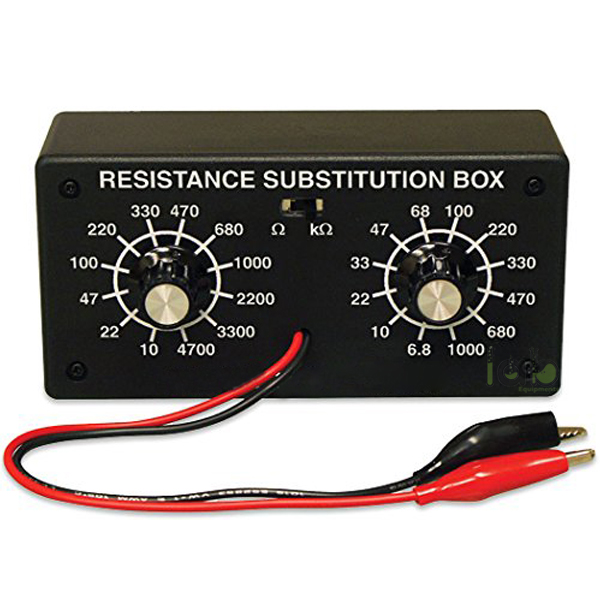
Resistance Substitution Box
Product Code : EL-EAE-10283
A resistance substitution box, also called a resistor substitution box, lets a student try different resistor values in a circuit without soldering. It holds 12 radio-type metal film resistors, 0.25 W and ±1%, at standard preferred values from 100 Ω to 470 kΩ. Each resistor has its own terminal, and every value is taken against one common terminal.
Specifications of the substitution box
| Component | Specification |
|---|---|
| Resistors | 12, radio-type metal film |
| Values | 100, 220 and 470 Ω; 1, 2.2, 4.7, 10, 22, 47, 100, 220 and 470 kΩ |
| Power rating | 0.25 W each |
| Tolerance | ±1% |
| Range | 100 Ω to 470 kΩ |
| Selection | One resistor between each labelled terminal and the common terminal |
| House code | EL-EAE-10283 |
| Manufacturer | Lab Exports, Delhi |
Circuit tasks for the substitution box
Clip one circuit lead to the common terminal. Move the other lead from terminal to terminal, and each resistor joins the circuit in turn. When one value gives the result you want, fit a fixed resistor of that preferred value. The safe voltage across a resistor is the lower of its working-voltage rating and √(PR), where P is the 0.25 W rating and R is the value selected.
- Base resistor for a transistor. Wire a simple common-emitter stage with an NPN transistor unit and an ammeter in the collector lead. Use the box as the base resistor and try several values. A larger base resistor gives a smaller base current, so the collector current falls.
- Series resistor for a diode. Put the box in series with a PN junction diode unit across a battery eliminator. Start from the highest value and step down until the forward current is enough for the readings.
- Substitution measurement. Note the current through an unknown resistor in a simple series circuit. Swap the box in for the resistor and find the terminal that gives the nearest current. That preferred value is a close estimate of the unknown.
- Checking nominal values. Measure from the common terminal to each terminal with a digital multimeter. Each reading should match its nominal value to within the ±1% tolerance, plus the error of the meter itself.
Frequently Asked Questions
What is a resistance substitution box?
It is a box of fixed resistors that can be put into a circuit one at a time. This one holds 12 radio-type metal film resistors of 0.25 W and ±1%, at preferred values from 100 Ω to 470 kΩ. Each resistor is wired between its own terminal and a common terminal.
How is a substitution box used in a circuit?
Wire it in where the uncertain resistor will go, with one lead on the common terminal. Switch off, move the other lead to a terminal, then switch on and note the result. Repeat with other terminals until the circuit behaves as required.
Why use a substitution box instead of changing fixed resistors?
It saves time and spares the circuit. Each new value needs only one lead moved, with no soldering or unsoldering. The board and component leads are not heated again and again, and all the trial values stay together in one box.
How does a substitution box differ from a decade box?
A substitution box offers a set of fixed values, taken one at a time. A decade box adds its dial settings in series, so it can be set in small steps across its range. The substitution box is quicker for trying standard values in a circuit.
Other ways to set a resistance in a circuit
- Resistance Box Plug Type
- Decade Resistance Box, Dial Type
- Resistance Box Electronic Type
- Rheostat Constantine (Eureka) Wire
More apparatus is in the Electrical and Electronics section of the Physics Lab range.
To enquire, email [email protected] with the house code EL-EAE-10283 and the quantity, or use the Add To Cart button on this page.
Last updated: 23 November 2026