Solar Energy Kit with Lamp

Product Code : SCL-EAE-11145
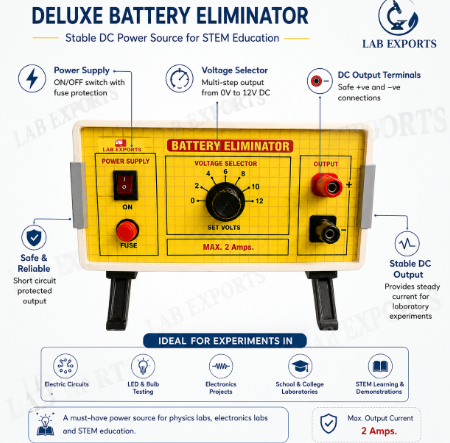
This kit is used to teach the photovoltaic effect. Its 12 V, 10 W lamp, run from a separate external supply, shines on a 3 V, 1 W photovoltaic module. The module turns the light into electrical energy, which drives a low-inertia motor. The kit suits renewable-energy and basic electricity lessons, as a teacher-led demonstration or as supervised practical work.
Specifications of the solar energy kit
| Component | Specification |
|---|---|
| Kit type | Solar (photovoltaic) energy teaching kit |
| Lamp | 12 V, 10 W, the light source for the module |
| Lamp supply | External 12 V supply, on a circuit separate from the module; it must carry at least the 0.83 A lamp load and take the switch-on surge |
| Photovoltaic module | Nominal 3 V, 1 W |
| Output device | Low-inertia motor |
| Connections | Leads and DC test points |
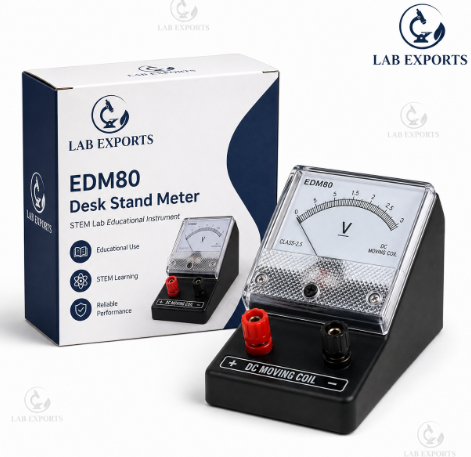
| Meters, optional | 0 to 5 V and 0 to 500 mA |
| Principle | Photovoltaic conversion of light into electrical energy |
| Illumination | Varied by lamp distance and angle, or by covering part of the module; the output of the module follows the light it receives |
| Use | Teacher-led demonstrations and supervised practical work |
| House code | SCL-EAE-11145 |
| Manufacturer | Lab Exports, Delhi |
Lessons with the solar cell and lamp
A solar cell is a semiconductor junction. Light absorbed in the cell frees charge carriers, and the electric field at the junction separates them, so a voltage appears across the cell. Joined to a load, the cell drives a current. More light on the cell gives more current, which is why a solar panel gives different outputs at different times of day.
- From light to electricity. Set the kit on a stable bench. Run the lamp from its external 12 V supply, and join the motor to the module with the leads. Shine the lamp on the module and watch the motor turn. Switch the lamp off and the motor stops. Students trace the energy from the lamp to the module, where it becomes electrical energy, and on into motion.
- Distance and angle. Move the lamp away from the module in steps, then tilt the module away from the lamp. The motor slows as less light reaches the module. At each position, hold a solar irradiance meter beside the module and note its reading. With the optional 0 to 5 V and 0 to 500 mA meters on the DC test points, record the module voltage and current as well.
- Shading. Cover part of the module with a card and compare the motor speed with the module fully lit. A smaller lit area gives a smaller current.
- Further work. To plot the V-I curve of a cell, move on to the solar cell characteristics apparatus. To follow light energy on into motion and back into electricity, use the Solar Wind Dynamo Model.
Frequently Asked Questions
Does a solar cell work under a lamp?
Yes. A solar cell responds to any light whose photons carry enough energy to free charge carriers in it, whether the light comes from the Sun or from a lamp. A lamp near the cell is usually weaker than direct sunlight, so the output is smaller and changes sharply with distance. This kit lights its module with a 12 V, 10 W lamp.
Why does a solar cell give no output at night?
Because no light reaches it. A solar cell does not store energy; it converts light into electrical energy only while light falls on it. Covering the module in class shows the same effect, as the motor stops at once.
Could the cell keep its own lamp lit for ever?
No. Some of the light from the lamp misses the cell, and the cell turns only a fraction of what it receives into electrical energy. The rest ends up as heat. So the cell can never return enough energy to run the lamp that lights it, because energy cannot be created. In this kit the lamp has its own 12 V supply.
How does a photovoltaic cell work?
It works in three steps. Light is absorbed in the semiconductor and frees electrons, leaving holes behind. The electric field at the junction pushes the electrons and holes apart. They are collected at the contacts and flow round the outside circuit as a current.
Is the photovoltaic effect the same as the photoelectric effect?
No, though both start with light freeing electrons. In the photoelectric effect, light knocks electrons out of a metal surface. In the photovoltaic effect the freed charges stay inside the semiconductor, and the field at the junction sends them round a circuit, so the cell itself produces a voltage.
Other solar energy kits and models
More apparatus is in the Electrical and Electronics section of the Physics Lab range.
To enquire, email [email protected] with the house code SCL-EAE-11145 and the quantity, or use the Add To Cart button on this page.
Last updated: 23 November 2026