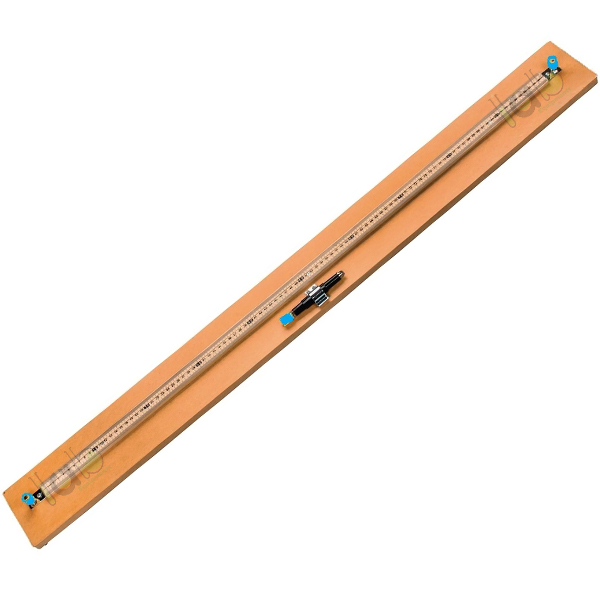
Potentiometer with Jockey Pencil
Product Code : EL-EAE-10290
This slide-wire potentiometer measures emf by balancing, so at the null point no current flows from the cell under test. Students use it to compare the emfs of two cells, find the internal resistance of a cell and measure small potential differences. A bare constantan wire runs over a 100 cm wooden scale on a wooden base with brass blocks. It has 4 mm socket terminals and a jockey.
Specifications of the potentiometer
| Component | Specification |
|---|---|
| Base | Wooden, with brass blocks |
| Wire | Uniform bare constantan, about 0.56 mm diameter (about 24 SWG), about 2.0 Ω/m at 20 °C |
| Wire length | Single run of 1000 mm over the scale, or a return-wire version with 2 m on the 1 m board |
| Scale | 100 cm wooden scale |
| Terminals | 4 mm socket terminals |
| Jockey | Supplied with the potentiometer |
| House code | EL-EAE-10290 |
| Manufacturer | Lab Exports, Delhi |
Emf and internal resistance practicals
A steady supply, a key and a rheostat send a constant current along the uniform wire. The fall of potential per centimetre is then the same along its whole length. When a cell is balanced against this fall through a galvanometer and the jockey, its emf is proportional to the balancing length.
- Ratio of two emfs. Link a Leclanche cell and a Daniell cell to a two-way plug key, so either cell can be switched to the galvanometer. Balance the first cell at length l1 and the second at l2. Then E1/E2 = l1/l2.
- Internal resistance by shunting the cell. Keep a rheostat in the main circuit to fix the current. Balance the cell with nothing across it, giving length l1. Then close a key that connects a known resistance R in parallel with the cell, and balance again to get l2. The internal resistance r = R(l1 - l2)/l2.
Keeping potentiometer readings reliable
- Join the positive terminal of the cell under test to the wire end that takes the positive of the main supply.
- The fall of potential across the whole wire must be larger than the emf being measured, or no balance point appears.
- On the return-wire version, the terminals you connect decide whether 1 m or 2 m of wire is in use.
- Press the jockey down at single points and lift it again, rather than dragging it along the wire.
- At the end of the set, balance the first cell again. If the length has changed, the main current has drifted and the readings should be repeated.
Documentation and supply
Installation instructions and a manual are supplied with the apparatus. Most Lab Exports products carry a one-year manufacturer warranty.
Lab Exports manufactures the potentiometer at its works in Laxmi Nagar, Delhi, and supplies it to schools, colleges and universities in India and 60+ countries, handling the export documents for each shipment. More about the company is on the About Lab Exports page.
Frequently Asked Questions
What is the working principle of a potentiometer?
When a steady current flows through a wire of uniform cross-section, the fall of potential along it is proportional to the length. A cell balanced against part of the wire therefore has an emf proportional to the balancing length. At balance no current flows from that cell.
What does a potentiometer mainly measure?
It measures emf and potential difference by a null method. Because no current is taken from the cell at balance, it gives the true emf, not the lower terminal voltage a voltmeter would show. With this apparatus students compare emfs, find internal resistance and measure small potential differences.
What is the difference between emf and terminal voltage?
Emf E is the potential difference across a cell when it supplies no current. Terminal voltage V is the value while it supplies a current I, and V = E - Ir, where r is the internal resistance. The internal resistance practical on this potentiometer uses exactly this difference.
Spares and companions for potentiometer work
More apparatus is in the Electrical and Electronics section of the Physics Lab range.
To enquire, email [email protected] with the house code EL-EAE-10290 and the quantity, or use the Add To Cart button on this page. Tender buyers can also see the Tenders and OEM page.
Last updated: 23 November 2026