Hoffman Voltameter
Product Code : EL-EAE-10294
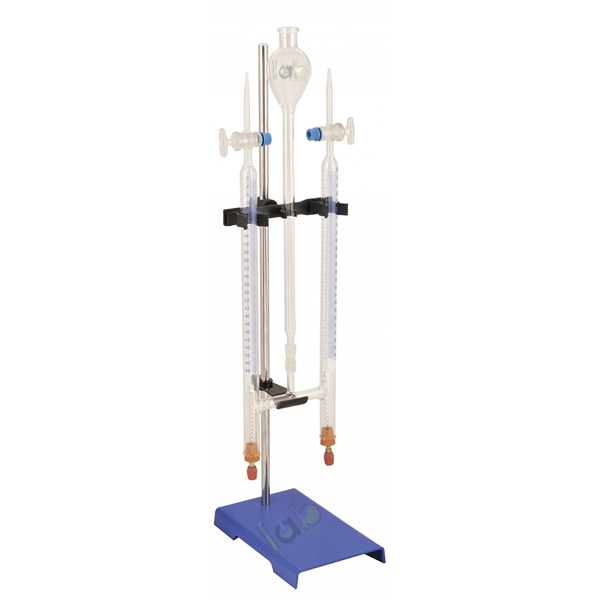
This Hoffman voltameter is a glass water voltameter with removable carbon electrodes. Its two connected limbs are each graduated 50 × 0.2 ml and closed by stopcocks. A connecting tube leads to a funnel-shaped reservoir bulb for filling. Electrolysis of acidified water gives two volumes of hydrogen for each volume of oxygen. The name is also written Hofmann.
Specifications of the Hoffman voltameter
| Component | Specification |
|---|---|
| Construction | Glass, two connected limbs |
| Graduation | Each limb 50 × 0.2 ml |
| Electrodes | Carbon, removable for cleaning or replacement |
| Stopcocks | For releasing and testing the collected gases |
| Filling | Connecting tube and funnel-shaped reservoir bulb |
| Mounting, separate | Stand, boss head and padded clamp, holding the glass upright and clear of the stopcocks |
| Electrical, separate | DC supply and leads |
| House code | EL-EAE-10294 |
| Manufacturer | Lab Exports, Delhi |
Experiments with the Hoffman voltameter
Pure water conducts very poorly, so a little dilute sulphuric acid is added. With direct current, hydrogen forms at the cathode (negative electrode) and oxygen at the anode (positive electrode): 2H2O → 2H2 + O2. Each gas rises into its own graduated limb.
- Watching the ratio settle. Run the voltameter from a low-voltage DC source such as an IC Regulated Battery Eliminator. Read both limbs at regular intervals and work out the hydrogen to oxygen ratio each time. Early ratios often come out above 2:1, then move closer to 2:1 as the run goes on.
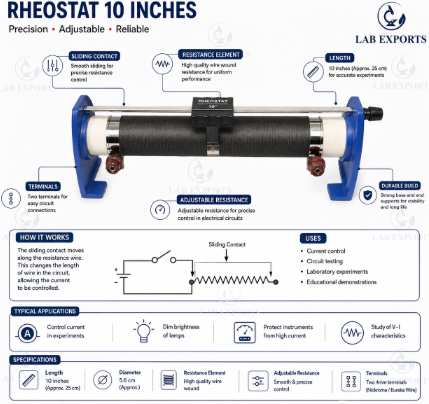
- Gas volume and current. Put an ammeter and a rheostat in series with the voltameter. Run once at a lower and once at a higher current for the same time, starting with full limbs each time. More current gives more gas, because the amount of gas set free depends on the charge passed.
Filling and care of the voltameter
- Fix the voltameter upright on a stand, using a metal bosshead and a padded clamp such as a retort clamp with rubber jaws. Keep the clamp clear of the stopcocks.
- With both stopcocks open, fill the apparatus with acidified water through the funnel-shaped reservoir bulb. Close the stopcocks once the liquid reaches them in both limbs.
- Connect the carbon electrodes to the DC supply, noting which limb is joined to the negative terminal.
- After reading the volumes, open one stopcock at a time to let a little gas out. Hold a lighted splint at the hydrogen outlet for a squeaky pop, and a glowing splint at the oxygen outlet to see it relight.
- At the end, drain the acid and rinse the glass with water. Take out the carbon electrodes for cleaning, or replace them when worn.
Frequently Asked Questions
How is a voltameter different from a voltmeter?
A voltameter is an electrolysis cell, while a voltmeter is a meter. This voltameter splits water and collects the gases in graduated limbs. A voltmeter measures the potential difference between two points in a circuit. The names look alike, but the two do quite different jobs.
Must the measured ratio be exactly 2:1?
No, not at the start. Oxygen is a little more soluble in water than hydrogen, so some of the first oxygen dissolves and the oxygen limb reads low. As the water becomes saturated, the ratio comes closer to 2:1.
Is a specific voltage required for the electrolysis?
No single value is fixed, but the supply must be low-voltage direct current. Raise it until bubbles form steadily at both electrodes. More current gives gas faster, but too much current heats the electrolyte, so keep the current moderate.
Other apparatus for electrolysis practicals
More apparatus is in the Electrical and Electronics section of the Physics Lab range.
To enquire, email [email protected] with the house code EL-EAE-10294 and the quantity, or use the Add To Cart button on this page.
Last updated: 23 November 2026