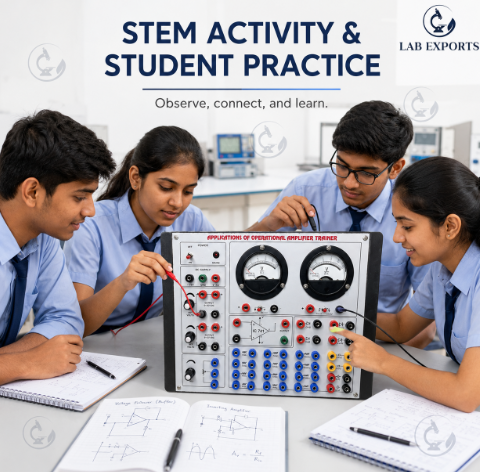
Operational Amplifier Trainer
Product Code : SCL-EAE-11182
This operational amplifier trainer carries its own signal source: a built-in sine and square wave generator covering 10 Hz to 100 kHz at 0.1 to 5 V peak-to-peak. Beside it, a regulated ±12 V dual supply powers the 741-class op-amp. Schematic circuit blocks on the front panel are joined with stackable insulated patch leads. AC work on amplifiers, filters, integrators and comparators needs no separate function generator; the waveforms are viewed on an oscilloscope.
Specifications of the op-amp trainer
| Component | Specification |
|---|---|
| Enclosure | Powder-coated steel console |
| Power supply | Regulated dual-polarity DC supply, ±12 V rails |
| Op-amp | 741-class general-purpose operational amplifier |
| Signal source | Built-in sine and square wave generator, 10 Hz to 100 kHz, amplitude 0.1 to 5 V peak-to-peak into a high-impedance load |
| Front panel | Schematic circuit blocks with insulated patch sockets |
| Circuits built | Amplifiers, adders, subtractors, integrators, differentiators, active filters, precision rectifiers and comparators |
| Connections | Stackable insulated patch leads |
| Mains connection | 3-wire AC power cable |
| Supplied with | Trainer console, an assortment of stackable insulated patch leads, the power cable and a technical instruction manual with sample lab procedures |
| House code | SCL-EAE-11182 |
| Manufacturer | Lab Exports, Delhi |
Measuring op-amp behaviour with the built-in generator
A real op-amp is not ideal. Its output can only change so fast, its gain falls at high frequencies, and it does not reject common signals perfectly. The generator lets students see these limits on an oscilloscope, with the input and output traces side by side. The 10 Hz to 100 kHz span is the rating of the generator. How far an amplifier block follows it at the top end depends on its gain, bandwidth and slew rate.
- Slew rate. Set up a unity-gain amplifier and feed it the square wave. At a high enough frequency the sharp edges of the output turn into straight ramps. Measure the voltage change of one ramp and the time it takes: their ratio is the slew rate.
- Frequency response and bandwidth. Feed a small sine wave into an amplifier block and raise the frequency step by step at constant input. Record the output amplitude, from the oscilloscope or, at lower frequencies, as an AC reading on a digital multimeter. The upper cut-off is where the output has fallen to 1/√2 of its mid-band value.
- Common-mode rejection. Set up the subtractor and apply the same signal to both inputs. A small output remains, which gives the common-mode gain. Then drive the inputs differentially for the differential gain. The input stage behind this is a transistor differential pair, which can be wired from separate parts on the Discrete Component Trainer.
- Active filters. Sweep the sine frequency through a filter block and plot output against frequency, to find the pass band and where the response rolls off.
Frequently Asked Questions
What waveforms does the built-in generator give?
It gives sine and square waves from 10 Hz to 100 kHz, at 0.1 to 5 V peak-to-peak into a high-impedance load. The sine wave suits gain, frequency response and filter work. The square wave suits the integrator, the differentiator and slew rate tests, because its sudden edges show how fast a circuit can follow.
Is an oscilloscope needed with this trainer?
Yes, for waveform work. The trainer provides the supply and the signal, and a dual-trace oscilloscope shows the input and output together. Simple DC readings, and AC readings at lower frequencies, can be taken with a digital multimeter.
What is slew rate, and how is it measured in the lab?
Slew rate is the fastest rate at which the op-amp output voltage can change, usually given in volts per microsecond. Feed a square wave into a unity-gain amplifier. On the oscilloscope the output edges become sloped, and the voltage change divided by the rise time gives the slew rate.
What is CMRR?
CMRR, the common-mode rejection ratio, is the differential gain divided by the common-mode gain, often stated in decibels. A high CMRR means the op-amp responds strongly to the difference between its inputs and hardly at all to noise or hum that reaches both inputs equally.
How is slew rate related to bandwidth?
A sine wave of peak voltage Vp and frequency f changes fastest at 2πfVp. When this exceeds the slew rate, the output turns triangular and distorts. So the highest frequency for a full, clean output, the full-power bandwidth, equals the slew rate divided by 2πVp.
Other electronics trainers
More apparatus is in the Electrical and Electronics section of the Physics Lab range.
To enquire, email [email protected] with the house code SCL-EAE-11182 and the quantity, or use the Add To Cart button on this page.
Last updated: 23 November 2026