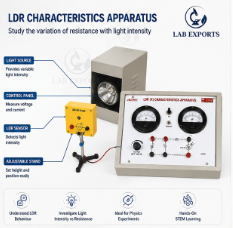
LDR Characteristics Apparatus
Product Code : SCL-EAE-11203
This apparatus is used to study a light-dependent resistor, or photoresistor. A built-in regulated 5 V DC rail powers it. Students turn up an adjustable white LED in steps, at a fixed spacing inside a light shield, and record the resistance, voltage or current. They plot how resistance falls as illumination rises. It also introduces light sensors and the voltage-divider circuits behind automatic lighting.
Specifications of the LDR characteristics apparatus
| Component | Specification |
|---|---|
| Experiment | Study of light-dependent resistor (LDR) characteristics |
| Measured quantities | Resistance, voltage or current |
| Parts on the set-up | LDR, light source with its control, light shield and test terminals |
| Power supply | Built-in regulated 5 V DC rail |
| Light source | Adjustable white LED, at a fixed spacing from the LDR |
| Meter arrangement | Resistance read with a multimeter on the disconnected LDR, or through a known divider with a 0 to 5 V voltmeter |
| Illumination reading | Taken independently with a lux meter |
| Result | Graph of resistance against illumination |
| House code | SCL-EAE-11203 |
| Manufacturer | Lab Exports, Delhi |
LDR practicals and sensor tasks
- Resistance against light. Set the LED to its lowest level and read the illuminance on a lux meter. Disconnect the LDR and read its resistance with a digital multimeter. Raise the light in steps and repeat.
- Current at a fixed voltage. Keep the voltage across the LDR steady from the 5 V rail and note the current on an ammeter. The current rises as the light increases.
- Plot the curve. Plot resistance against illumination. The graph falls steeply at low light levels and flattens in bright light.
- Light-sensing circuit. Join the LDR in series with a fixed resistance from a plug-type resistance box to make a voltage divider on the 5 V rail. Read the voltage across the fixed resistance with a 0 to 5 V voltmeter. It rises with light, which is the signal that can switch a lamp or buzzer.
Documentation and supply
Most Lab Exports products carry a one-year manufacturer warranty.
Lab Exports manufactures the LDR characteristics apparatus at its works in Laxmi Nagar, Delhi, and supplies it to schools, colleges and universities in India and 60+ countries, handling the export documents for each shipment. More about the company is on the About Lab Exports page.
Frequently Asked Questions
What does the LDR characteristics apparatus include?
The set-up carries the LDR, an adjustable white LED at a fixed spacing, a light shield, test terminals and a built-in regulated 5 V DC rail. Resistance is read with a multimeter on the disconnected LDR, or through a known divider with a 0 to 5 V voltmeter. A lux meter gives the light level.
Which specifications of an LDR should be checked?
The main ones are dark resistance, resistance at a stated light level, maximum voltage and power, the colours of light it responds to, and response time. On this apparatus the light comes from an adjustable white LED, and the circuit runs from a regulated 5 V DC rail.
Why does LDR resistance decrease as light intensity increases?
Light absorbed by the semiconductor frees more charge carriers. With more carriers to carry current, the material conducts better, so its resistance falls. In darkness few carriers are free and the resistance is high.
Which law links the light reaching the LDR to the distance of the lamp?
The inverse square law. For a small lamp, the illuminance on the LDR is proportional to 1/d2, where d is the distance from the lamp. On this apparatus the spacing is fixed, so the light is changed with the LED control instead. A light shield keeps out stray room light.
Why do LDRs have a slow response time?
The charge carriers freed by light take time to build up, and time to recombine when the light falls. The resistance therefore takes a moment to settle, most of all after a change from bright to dark. Let each reading steady before you record it.
Other semiconductor practicals in the range
More apparatus is in the Electrical and Electronics section of the Physics Lab range.
To enquire, email [email protected] with the house code SCL-EAE-11203 and the quantity, or use the Add To Cart button on this page.
Last updated: 23 November 2026