Inductive Load
Product Code : SCL-EAE-11305
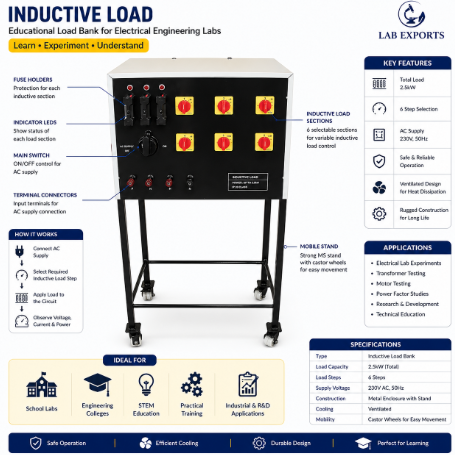
An inductive load draws current that lags the applied AC voltage because energy is stored temporarily in its magnetic field. The apparatus enables students to observe how inductance affects current, apparent power, reactive power and circuit power factor.
The unit may use coils, reactors or another inductive loading arrangement, depending on the supplied configuration. Its rated voltage, current, frequency, phase arrangement, inductance value, reactive-power capacity, adjustment method and construction must be confirmed before procurement or publication.
Key Features
Inductive loading: Introduces a controlled lagging load into a compatible AC circuit.
Power-factor demonstration: Helps students observe the effect of inductance on phase angle and power factor.
Reactive-power study: Supports practical measurement of voltage, current, active power and reactive power.
Adjustable configuration: Loading may be varied in steps or continuously, subject to the confirmed design.
Laboratory terminals: Provides accessible connections for integration with meters, trainers and electrical machines.
Educational application: Suitable for supervised electrical engineering and power-system experiments.
Reusable test equipment: Designed for repeated laboratory demonstrations within its rated duty limits.
Technical Specifications
|
Specification |
Detail |
|
Product name |
Inductive Load |
|
Brand |
Lab Exports |
|
Equipment type |
AC inductive or reactive loading unit |
What’s Included in the Kit
One Inductive Load unit
Integrated inductive elements or reactor assembly
Load-selection or adjustment controls, where applicable
Electrical input and output terminals
Connecting cables, meters and instructions only when stated in the quotation
Applications and Uses
Demonstrating lagging current in AC circuits
Studying active, reactive and apparent power
Measuring power factor under inductive loading
Testing alternators, transformers and compatible AC machines
Comparing resistive, inductive and capacitive loads
Conducting power-factor correction experiments
Supporting electrical engineering and vocational training
How to Use the Inductive Load
Check the rated voltage, current, frequency and phase configuration.
Set the load control to its minimum-load position.
Isolate the electrical supply before making connections.
Connect the load according to the approved laboratory circuit diagram.
Verify earthing, terminal tightness and protective-device settings.
Energise the circuit under qualified supervision.
Increase the inductive load gradually while monitoring current, voltage, power and temperature.
Record the phase or power-factor changes required by the experiment.
Return the control to minimum load before switching off.
Safety note: Inductive circuits can produce hazardous voltage transients when switched. Use suitable isolation, earthing and overcurrent protection, and never alter connections while the circuit is energised.
Care & Maintenance
Inspect terminals, insulation, cables and earthing before operation.
Keep ventilation openings clear and allow the unit to cool after use.
Protect the apparatus from moisture, dust and mechanical impact.
Do not exceed the confirmed electrical ratings or permitted duty cycle.
Why Choose Lab Exports
Lab Exports manufactures and exports scientific laboratory instruments, experiment setups, educational kits, didactic models and STEM equipment. Its product range supports practical electrical measurement and technical training. Equipment is supplied for schools, colleges, universities, vocational institutes and international procurement. Buyers should approve the complete electrical and safety specification before ordering. As a trusted physics demonstration kit India supplier, we regularly export to customers across Ethiopia (East Africa), Indonesia (Southeast Asia) and Suriname (South America), backed by responsive support and dependable logistics.
Frequently Asked Questions
What is an inductive load used for?
It is used to apply a lagging reactive load to an AC circuit for studying current, phase angle, reactive power and power factor.
How does an inductive load affect power factor?
An inductive load causes current to lag voltage. This produces a lagging power factor unless corrective capacitance is added.
Can it be used for power-factor correction experiments?
Yes. It can be combined with a compatible capacitor bank to study how capacitance compensates for inductive reactive power.
Is the unit single-phase or three-phase?
The phase configuration has not been confirmed. Buyers should specify the required single-phase or three-phase version.
Does an inductive load become hot?
Yes. Its windings can generate heat during operation, so ventilation and the stated duty limits must be observed.
Can students operate the apparatus?
Students may use it only under direct supervision by qualified teaching or technical personnel because it may operate at hazardous voltage and current levels.
Request confirmed voltage, current, phase and reactive-power ratings for the Inductive Load, or explore related Electrical and Electronics Equipment, Lab Meters, the Electrical Transformer and complete Physics Lab Equipment range from Lab Exports.