Loading Rheostat 1.2KW Bank
Product Code : SCL-EAE-11312
This loading rheostat bank is an adjustable resistive load rated at 1.2 kW, sized for bench work. Selection switches or a load-adjustment control change its resistance, and so the current drawn. Students use it to study voltage drop, current and power dissipation, and to load DC power supplies and small machines.
Specifications of the 1.2 kW loading rheostat bank
| Component | Specification |
|---|---|
| Equipment type | Adjustable resistive-load bank |
| Rated loading capacity | 1.2 kW |
| Load characteristic | Resistive |
| Control | Load-adjustment control or selection switches |
| Connections | Electrical connection terminals |
| Confirmed in the quotation | Resistance range, rated voltage, maximum current and cooling arrangement |
| House code | SCL-EAE-11312 |
| Manufacturer | Lab Exports, Delhi |
Bench experiments with the 1.2 kW bank
Power in a resistor can be written three ways: P = VI = I2R = V2/R. V, I and R are the voltage across the bank, the current in it and its resistance. The energy taken from the source appears as heat in the elements of the bank.
- Three forms of power compared. With the supply off, set one position of the bank and measure its resistance R on a digital multimeter. Then connect it across a DC source with a digital LCD ammeter in series with it and a digital LCD voltmeter across its terminals. Work out VI, I2R and V2/R and see how closely they agree.
- Load test on a DC power supply. Load a supply such as the IC Regulated Power Supply, within its current rating, starting from minimum load. Record the output voltage at each setting and plot it against load current. The slope shows how well the supply holds its voltage.
- A known steady load. Leave the bank at one setting as a fixed load while students practise wiring meters and reading current and voltage in a circuit-training exercise.
Before each bench run
- Confirm the voltage, current, resistance and 1.2 kW ratings against the source.
- Set the control to minimum load, which is maximum resistance.
- Isolate the supply and connect the bank as per the experiment diagram.
- Check terminal tightness, earthing and protection, then switch on and raise the load gradually while taking readings.
Frequently Asked Questions
Where is a tube rheostat used, and where a loading rheostat?
A tube rheostat controls small currents in bench circuits, as a current limiter or a potential divider. A loading rheostat bank such as this 1.2 kW one takes the whole output of a source, so it is used in load tests on power supplies, generators and motors.
Why use a load bank instead of the real load for testing?
A load bank gives a known load that can be set, repeated and switched off at will. Real equipment draws whatever it needs at the moment, so it cannot be held at chosen values while readings are taken.
If P = I2R and P = V2/R, does more resistance mean more power or less?
It depends on what stays fixed. Across a constant-voltage source, P = V2/R, so lowering the resistance raises the power drawn. With a fixed current, P = I2R rises with resistance. On a DC supply, turning this bank to lower resistance increases the load.
Why does voltage regulation matter in a power supply?
Good regulation keeps the output voltage nearly steady as load current changes, so the circuits it feeds work as designed. Loading a supply through this bank from minimum to maximum current shows how far its output falls.
Other resistive loads for bench and machine tests
- Rheostat 12 Inches, a tube rheostat for small currents
- Loading Rheostat 3KW Bank
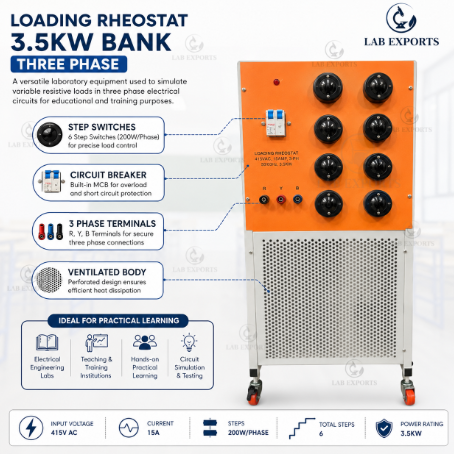
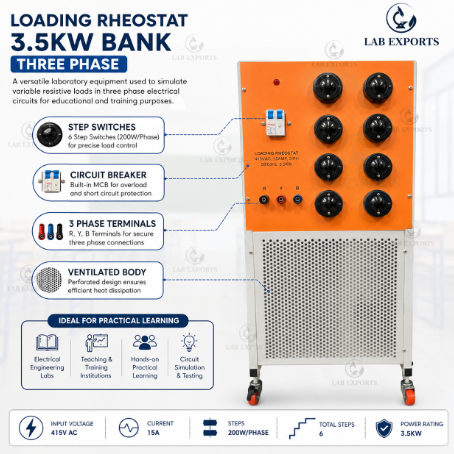
- Loading Rheostat 3.5KW Bank
- Lamp Load 2.5KW
More apparatus is in the Electrical and Electronics section of the Physics Lab range.
To enquire, email [email protected] with the house code SCL-EAE-11312 and the quantity, or use the Add To Cart button on this page.
Last updated: 23 November 2026