Zener Diode Apparatus

Product Code : SCL-EAE-11322
This apparatus is set up to study a Zener diode in both directions. The diode polarity, the series current-limiting resistance and the measurement points are easy to pick out. Students record diode voltage and current, draw the full V-I curve, read off the breakdown voltage and show simple shunt regulation.
Specifications of the Zener diode apparatus
| Component | Specification |
|---|---|
| Device studied | Zener diode |
| Apparatus type | Semiconductor characteristics apparatus |
| Primary experiments | Forward characteristic, reverse breakdown and basic voltage regulation |
| Readings taken | Diode voltage and diode current, for V-I curve plotting |
| Easy to identify | Diode polarity, series current-limiting resistance and measurement points |
| Brand | Lab Exports |
| House code | SCL-EAE-11322 |
| Manufacturer | Lab Exports, Delhi |
Experiments on the Zener diode apparatus
Forward biased, a Zener diode conducts like an ordinary silicon diode. In reverse it blocks, apart from a tiny leakage, until it breaks down at VZ. Beyond breakdown the diode voltage barely moves, even as the current grows. Always keep the current within the diode rating.
- The whole curve on one graph. Take forward readings in small steps, then reverse the connections and raise the reverse voltage slowly. Plot forward values in the first quadrant and reverse values in the third. Mark VZ where the reverse curve turns almost vertical.
- Holding the output steady. With the series resistor in circuit and the diode in breakdown, raise the input voltage in steps. Read the voltage across the diode with a digital multimeter. It changes very little while the input rises. This is the basic shunt regulator.
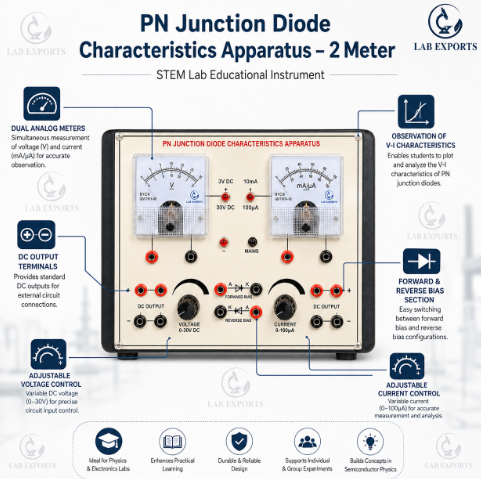
- Zener against an ordinary diode. Repeat the reverse readings on the PN Junction Diode Characteristics Apparatus. Over the same low reverse voltages the ordinary diode shows only a small leakage current, so it cannot act as a voltage reference.
Documentation and supply
Most Lab Exports products carry a one-year manufacturer warranty.
Lab Exports manufactures the Zener Diode Apparatus at its works in Laxmi Nagar, Delhi, and supplies it to schools, colleges and universities in India and 60+ countries, handling the export documents for each shipment. More about the company is on the About Lab Exports page.
Frequently Asked Questions
Why does a Zener diode experiment need both a microampere and a milliampere current range?
Below breakdown the reverse current is only a tiny leakage, which shows up on a microampere range. In forward conduction and after breakdown the current is in milliamperes. A meter with both ranges, or two meters, lets students record both parts of the curve.
Can the apparatus show regulation when the input voltage changes and when the load changes?
It is described for the input-voltage case: with the series resistor in circuit, the diode holds its voltage while the input rises. A load-change test, where the load resistance is varied at a fixed input, needs a variable load resistor. Ask about this when you enquire.
What is another name for a Zener diode?
It is also called a breakdown diode, because it is designed to operate in reverse breakdown. In circuits it is often described as a voltage reference diode or a voltage regulator diode.
What is Zener voltage?
Zener voltage VZ is the reverse voltage at which the diode breaks down and the reverse current starts to rise sharply. Beyond it the current can change a great deal with almost no change in diode voltage. On this apparatus it is read from the bend in the reverse curve.
What are the uses of a Zener diode?
Its main uses are as a voltage reference and as a simple shunt voltage regulator. It is also used to protect circuits from overvoltage and to clip a waveform at a set level. The regulator use is the one shown on this apparatus.
Other apparatus for diode characteristic practicals
More apparatus is in the Electrical and Electronics section of the Physics Lab range.
To enquire, email [email protected] with the house code SCL-EAE-11322 and the quantity, or use the Add To Cart button on this page.
Last updated: 23 November 2026