Domestic Circuit Apparatus
Product Code : SCL-EAE-11196
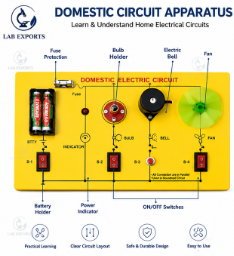
This working bench board shows how electricity is wired in a house, running from 6 V isolated AC. Two switched lamps in parallel, a fuse in the simulated live conductor and a low-voltage demonstration socket sit on a 300 x 200 mm base. Labelled live, neutral and earth paths let a teacher show why the switch and fuse sit in the live wire.
Specifications of the domestic circuit apparatus
| Component | Specification |
|---|---|
| Topic covered | Domestic electric circuits, part of school physics on the effects of electric current |
| Type | Working teaching board |
| Supply | 6 V isolated AC |
| Base | 300 x 200 mm |
| Loads | Two lamps in parallel, each with its own switch |
| Fuse | In the simulated live conductor |
| Socket | Low-voltage demonstration socket |
| Wiring shown | Labelled live, neutral and earth paths |
| Earth path | Shows the function of the protective earth for appliances with metal bodies |
| Suggested use | Teacher demonstration followed by supervised group discussion |
| House code | SCL-EAE-11196 |
| Manufacturer | Lab Exports, Delhi |
Teaching domestic wiring with the apparatus
Mains power reaches a house through a live wire and a neutral wire, with an earth wire as a separate safety path. The board puts these connections on the bench as a working circuit at 6 V AC. Pupils can then match the wiring rules to the switches, sockets and fuse boxes at home.
- Live, neutral and earth. Trace the three labelled paths on the board. Mark where the switch and the fuse are placed, and explain why both belong in the live wire.
- Parallel loads. Switch the two lamps on and off in turn. Each works on its own, just as each load in a house receives the full supply voltage and has its own switch. Then compare three lamps on the Lamps in Series Kit with three on the Lamps in Parallel Kit at low voltage.
- Overloading and short circuits. Discuss what happens when too many appliances run from one socket, or when the live wire touches the neutral. Pupils then find the fuse on the board, in the simulated live conductor, and see why it is there.
- Earthing. Follow the labelled earth path and explain how the protective earth guards the user of an appliance with a metal body.
Frequently Asked Questions
What does a domestic circuit apparatus demonstrate?
It demonstrates the layout of household wiring as a working circuit run from 6 V isolated AC. Live and neutral wires bring the supply, and an earth wire gives a separate safety path. Lamps, fans and sockets are joined in parallel, and the switch and fuse are placed in the live wire.
Which parts of a house circuit are shown on it?
It shows labelled live, neutral and earth paths and two lamps in parallel, each with its own switch. A fuse sits in the simulated live conductor, and there is a low-voltage demonstration socket. All of it is laid out on a 300 x 200 mm base.
Why is the switch connected in the live wire?
So that turning the switch off cuts the appliance off from the live supply. With the switch in the neutral wire, the appliance would stay connected to the live wire when off, and touching its parts could give a shock.
What is the role of the earth wire in domestic circuits?
It joins the metal body of an appliance to earth through a low-resistance path. If a live wire touches the body, a large current flows to earth and the fuse blows. The body therefore does not stay at a dangerous voltage.
What is a fuse, and how is it connected in a circuit?
A fuse is a short piece of wire with a low melting point. It is connected in series in the live wire. It works on the heating effect of current: when an overload or short circuit makes the current too large, the wire melts and breaks the circuit.
Apparatus for related electricity lessons
- Lamps in Series Kit
- Lamps in Parallel Kit
- Circuit Board Junior
- Good and Bad Conductor of Electricity
More apparatus is in the Electrical and Electronics section of the Physics Lab range.
To enquire, email [email protected] with the house code SCL-EAE-11196 and the quantity, or use the Add To Cart button on this page.
Last updated: 23 November 2026