Lamps in Series Kit
Product Code : SCL-EAE-11195
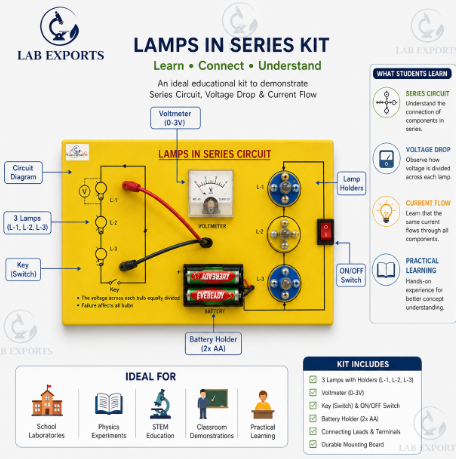
This baseboard circuit joins three MES lamp holders one after another in a single loop. An analogue 0 to 6 V DC voltmeter and a 0 to 0.5 A DC ammeter are fitted on the board. Students read one current for all three lamps, measure the voltage across each lamp, and see every lamp go out when one bulb is unscrewed. Its supply is 3 to 6 V DC.
Specifications of the lamps in series kit
| Component | Specification |
|---|---|
| Circuit | 3 lamp holders in series, with printed schematic lines on the board |
| Lamp holders | Miniature Edison Screw (MES) with brass contacts |
| Voltmeter | Analogue, 0 to 6 V DC, on the board |
| Ammeter | Analogue DC ammeter, 0 to 0.5 A, on the board |
| Input voltage | 3 to 6 V DC maximum |
| Base | Impact-resistant, non-conductive polymer (ABS/Bakelite) board, 290 x 150 x 50 mm |
| Terminals | 4 mm binding posts for banana plugs or crocodile clips |
| Weight | About 480 g |
| Supplied with | 3 low-voltage MES bulbs and 4 colour-coded leads with banana plugs |
| House code | SCL-EAE-11195 |
| Manufacturer | Lab Exports, Delhi |
Experiments with the series lamp board
Screw in the three bulbs and feed the input posts from cells or a battery eliminator kept between 3 and 6 V DC. With the bulbs in series there is only one path, so the same charge flows through each lamp in turn.
- One current everywhere. Note the board ammeter reading. Then put a separate ammeter at another point in the loop. Both meters show the same current.
- The supply voltage shares out. Take the on-board voltmeter across each lamp in turn, then across all three. The three lamp readings add up to the supply voltage, V = V1 + V2 + V3. With matched bulbs, each lamp takes about one third of it.
- Resistance of each lamp. Divide each lamp voltage by the current to find R1, R2 and R3. Their sum matches the supply voltage divided by the current, R = R1 + R2 + R3.
- Break the loop. Unscrew one bulb. Every lamp goes out and the ammeter drops to zero. Repeat on the Lamps in Parallel Kit, where the other lamps stay lit.
Documentation and supply
A teacher experiment manual and a student worksheet are supplied with the kit. Most Lab Exports products carry a one-year manufacturer warranty.
Lab Exports manufactures the lamps in series kit at its works in Laxmi Nagar, Delhi, and supplies it to schools and colleges in India and 60+ countries, handling the export documents for each shipment. More about the company is on the About Lab Exports page.
Frequently Asked Questions
What is included in this series circuit kit?
The kit has the series lamp board with its built-in voltmeter and ammeter, three low-voltage MES bulbs and four colour-coded leads with banana plugs. A teacher experiment manual and a student worksheet come with it. You add only a 3 to 6 V DC source.
What power supply does the kit need?
A DC supply of 3 to 6 V and no more. Cells or a battery eliminator set within that range will do. The on-board voltmeter reads up to 6 V DC, so a higher input would also push it off scale.
Where are the ammeter and voltmeter connected in a series circuit?
The ammeter goes in series, inside the single current path, so the whole current passes through it. The voltmeter goes in parallel, across the lamp or lamps being measured. On this board, take it across each lamp in turn and then across all three.
What happens to the total resistance when more bulbs are added in series?
It increases, because resistances in series add: R = R1 + R2 + R3. With the same supply voltage the current falls, so every lamp in the chain glows more dimly.
Which bulb glows brighter when a low-resistance and a high-resistance bulb are in series?
The high-resistance bulb glows brighter. Both bulbs carry the same current I, and the power in each is I2R, so the larger R takes more power. It also takes the larger share of the supply voltage.
How do the current and the lamp voltages compare in bulbs in series?
The current is the same through every lamp, so the 0 to 0.5 A ammeter reading does not depend on where it sits in the loop. The lamp voltages are shares of the supply and add up to it. Three matched bulbs take roughly a third each.
More apparatus for circuit practicals
- Lamps in Parallel Kit
- Resistance in Series and Parallel Apparatus
- Circuit Board Senior
- Battery Eliminator
More apparatus is in the Electrical and Electronics section of the Physics Lab range.
To enquire, email [email protected] with the house code SCL-EAE-11195 and the quantity, or use the Add To Cart button on this page. Tender buyers can also see the Tenders and OEM page.
Last updated: 23 November 2026