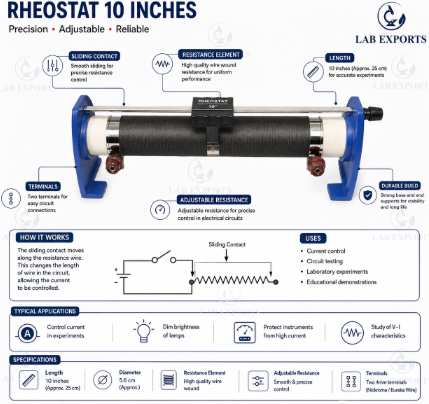
Loading Rheostat 3KW Bank

Product Code : SCL-EAE-11313
Rated at 3 kW, this loading rheostat bank gives an adjustable resistive load. Its resistance is lowered gradually or in steps to raise the current drawn, always at unity power factor. In DC machine practicals it sets the operating points for the external characteristics of DC generators. It can also load a motor through a coupled generator, and load power supplies.
Specifications of the adjustable 3 kW load bank
| Component | Specification |
|---|---|
| Equipment type | Adjustable resistive-load bank |
| Rated loading capacity | 3 kW |
| Load characteristic | Resistive, unity power factor |
| Control | Load-adjustment control or selection arrangement, for gradual or stepped changes |
| Connections | Electrical connection terminals |
| Confirmed in the quotation | Resistance range, voltage rating, maximum current, element material and cooling method |
| House code | SCL-EAE-11313 |
| Manufacturer | Lab Exports, Delhi |
DC generator characteristics on the adjustable bank
The bank resistance R sets the current the machine must supply, I = V/R, and the power it absorbs, P = V2/R, where V is the terminal voltage. Stepping R down from its maximum gives a run of operating points from light load to full load.
- Series generator. In a series generator the load current also flows through the field winding, so the machine builds up voltage only when the external circuit is closed through a low enough resistance. Read load current on a digital LED ammeter and terminal voltage on a digital LED voltmeter as the resistance is lowered. Over the working range the voltage rises with load current.
- Compound generator, both field connections. Take a set of readings with the series field aiding the shunt field, then reverse the series field and repeat. The cumulative connection holds its voltage up under load, while the differential connection makes it fall away steeply.
- Even steps for a clean graph. With a stepped control, read at every step. With a gradual control, set equal intervals of current on the ammeter. Plot terminal voltage against load current for each machine on one sheet.
Order of work at the bank
- Verify the resistance, voltage, current and 3 kW ratings before connection.
- Set the control to its minimum-load (maximum-resistance) position.
- Isolate the supply and wire the bank to the machine through the meters.
- Switch on, then reduce the resistance gradually or step by step within the rated limits, recording voltage and current each time.
Frequently Asked Questions
What is the principle of a resistive load bank?
It behaves as a pure resistance: current and voltage stay in step, and all the power taken from the source ends as heat in the elements. On this bank, each resistance setting fixes one operating point of the machine under test.
Why does the external characteristic of a shunt generator bend back after a certain point?
Because the falling terminal voltage also weakens the shunt field. As load resistance is lowered, current rises at first, but the voltage drops faster and faster. Past a point the voltage falls more than the resistance, so the current itself falls and the curve turns back.
Why is a water load used in the load test?
A water load is a simple variable resistive load: current passes through water between plates and heats it. An adjustable bank does the same job with resistance elements and a load-adjustment control.
Other loads for DC machine tests
More apparatus is in the Electrical and Electronics section of the Physics Lab range.
To enquire, email [email protected] with the house code SCL-EAE-11313 and the quantity, or use the Add To Cart button on this page.
Last updated: 23 November 2026