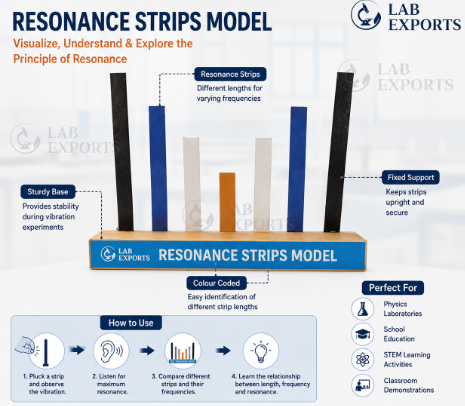
Resonance Strips Model
Product Code : SCL-EAE-11127
The Resonance Strips Model is a classroom demonstration of mechanical resonance. Six steel strips of different lengths stand on one holder. When the model is set vibrating, each strip responds according to its own natural frequency. The strip whose natural frequency matches the applied vibration swings far more widely than the rest. Teachers use it to separate ordinary forced vibration from resonance.
Specifications of the resonance strips model
| Component | Specification |
|---|---|
| Strips | Six, steel, on one common holder |
| Free lengths | About 70, 80, 90, 110, 120 and 130 mm |
| Strip section | About 8 mm wide and 0.5 mm thick |
| Excitation | By hand, shaking the common base, for a qualitative demonstration without a motor; or by an external wave driver and adjustable signal generator, both separate, for repeatable excitation |
| Principle | Mechanical resonance |
| Concepts covered | Natural frequency, forced vibration, resonance, amplitude, oscillation, energy transfer |
| House code | SCL-EAE-11127 |
| Manufacturer | Lab Exports, Delhi |
Teaching resonance with the strips
Every object that can vibrate has a natural frequency, set by properties such as its length, stiffness and mass. A periodic driving force makes every strip vibrate at the driving frequency, but most respond only weakly. The strip whose natural frequency equals the driving frequency takes in energy most efficiently and swings widely.
- Picking out the resonant strip. Stand the model on a stable bench and point out the six strip lengths. Shake the common base gently by hand at a steady rate and ask which strip moves most. Change the rate and a different strip takes over, which shows that resonance is selective. For repeatable runs, drive the model with an external wave driver fed from an adjustable signal generator, and raise the frequency slowly.
- Resonance of an air column. Move on to sound with a resonance apparatus. The air column sounds loudest when its natural frequency matches the tuning fork held over it, just as one strip swings most on the model.
- Resonance on a string. In Melde's apparatus a vibrating fork drives a stretched thread. Steady, large loops form only when the tension is set so that the thread resonates with the fork.
Documentation and supply
Most Lab Exports products carry a one-year manufacturer warranty.
Lab Exports manufactures the resonance strips model at its works in Laxmi Nagar, Delhi, and supplies it to schools, colleges and universities in India and 60+ countries, handling the export documents for each shipment. More about the company is on the About Lab Exports page.
Frequently Asked Questions
What is the difference between natural vibration and forced vibration?
A natural vibration is the free vibration of a body at its own natural frequency after it is disturbed and left alone. A forced vibration is kept going by an outside periodic force, and the body then vibrates at the frequency of that force, not its own.
What is the relationship between natural frequency and resonance?
Resonance happens when the driving frequency equals the natural frequency of the body. The amplitude then grows far larger than at other frequencies, because energy goes in at just the right moments. On this model only the strip matched to the driver swings widely.
How does the length of a strip affect its natural frequency?
A longer strip of the same material and thickness has a lower natural frequency, and a shorter one a higher frequency. On this model the strips run from about 130 mm down to 70 mm, so raising the driving frequency brings the shorter strips into resonance one after another.
What are everyday examples of resonance?
A swing goes higher when it is pushed in time with its own motion. A wine glass can ring when a steady note matches its natural frequency. Soldiers break step on a bridge so that their marching does not match a natural frequency of the bridge.
Other apparatus for natural frequency and resonance lessons
More apparatus is in the Electrical and Electronics section of the Physics Lab range.
To enquire, email [email protected] with the house code SCL-EAE-11127 and the quantity, or use the Add To Cart button on this page. Tender buyers can also see the Tenders and OEM page.
Last updated: 23 November 2026