Digital PN Junction Diode
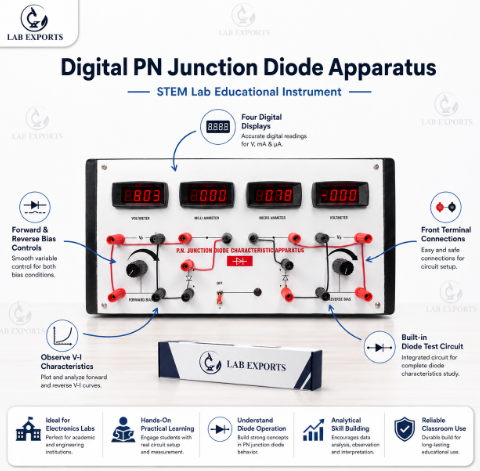
Product Code : SCL-EAE-11360
Built-in digital displays on this PN junction diode trainer give the voltage and the current as numbers. Students raise the bias in small steps, write down each pair and draw the V-I curve for both bias directions. With no pointer to interpret, their attention stays on how the junction behaves.
Specifications of the digital PN junction diode trainer
| Component | Specification |
|---|---|
| Experiment | Forward- and reverse-bias V-I characteristics of a PN junction diode |
| Measurement | Integrated digital voltage and current indication |
| Biasing | Forward and reverse on the same training panel |
| Documentation | Circuit diagram for the forward- and reverse-bias connections |
| Users | Schools, colleges, polytechnics and technical institutes |
| Display type, measuring ranges and supply rating | Confirmed by email with the house code |
| House code | SCL-EAE-11360 |
| Manufacturer | Lab Exports, Delhi |
Practicals on the digital trainer
Turn every control to minimum before switching on, and wire the diode as the supplied circuit diagram shows.
- Following the bend. In forward bias, raise the input in very small steps where the current begins to rise. The displays show each change at once, so the gradual rise near the knee is drawn from measured points.
- Reverse readings. Change over to reverse bias and stay within the rated range. The current display shows how small the reverse current stays below breakdown.
- A check with a second meter. Hold one forward setting and measure the diode voltage with a Digital Multimeter. The two numbers should agree closely; a large difference means a lead or a setting needs checking.
- Moving on to a transistor. The same step-and-record routine is used on the Digital Transistor Characteristics Apparatus to plot input and output characteristics.
Frequently Asked Questions
What features does a digital PN junction diode trainer have?
This trainer has built-in digital indication of voltage and current, forward and reverse bias on one panel, and controls and terminals laid out for supervised work. A circuit diagram is supplied. Display type, ranges and supply rating are confirmed by email.
What current ranges does a diode trainer need?
It must read both milliamperes and much smaller currents. Forward current past the knee is in milliamperes, while reverse current is far smaller, often microamperes or less. Ask for the measuring ranges of this trainer with the house code SCL-EAE-11360.
How do you find the knee voltage from the graph?
Look for the point where the forward curve bends from nearly flat to steeply rising. A common method is to extend the straight, steep part of the curve down to the voltage axis and read where it meets it. Close readings near the bend make this easier.
What are the sources of error in the PN junction diode experiment?
Loose or dirty connections head the list, followed by warming of the diode when current flows too long, and meter error. Digital displays remove parallax, but the last digit can flicker, so let it settle before writing it down.
Other apparatus with digital readout
More apparatus is in the Electrical and Electronics section of the Physics Lab range.
To enquire, email [email protected] with the house code SCL-EAE-11360 and the quantity, or use the Add To Cart button on this page.
Last updated: 23 November 2026