Battery Eliminator
Product Code : SCL-EAE-11164
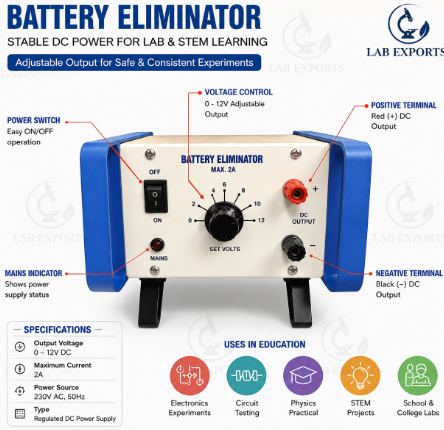
This battery eliminator runs from the mains and gives a low DC voltage in place of dry cells. A rotary selector sets 0, 2, 4, 6, 8, 10 or 12 V, with up to 2 A at the positive and negative terminals. An ON/OFF switch and a front-panel fuse are fitted. Its DC output comes in two versions: regulated, or unstabilised from a transformer and rectifier.
Specifications of the battery eliminator
| Component | Specification |
|---|---|
| Input | Mains operated; the regulated version takes 220 to 240 V AC, 50 Hz |
| Output type | DC, in two versions: regulated, or unstabilised from a transformer and rectifier, with ripple and a voltage drop that depend on the load |
| Output voltage | 0, 2, 4, 6, 8, 10 and 12 V, set by a rotary selector |
| Maximum output current | 2 A, marked on the front panel |
| Output terminals | Positive and negative |
| Controls | ON/OFF switch and rotary voltage selector |
| Protection | Front-panel fuse |
| House code | SCL-EAE-11164 |
| Manufacturer | Lab Exports, Delhi |
Circuits run from the battery eliminator
Dry cells run down during a practical and their voltage falls as they age. Here every group starts the lesson with the same supply, and each click of the selector changes the voltage by an equal 2 V step. On the unstabilised version a heavier load pulls the output down a little, so read the voltage on a meter rather than from the selector.
- Ohm's law. Join the positive terminal through a one way plug key to a Resistance Box 100 Ohms and an ammeter in series, back to the negative terminal. Connect a voltmeter across the resistance box. Read V and I at each step from the lowest setting upward, then draw the V-I graph with V on the vertical axis. Its slope is the resistance.
- Lamp brightness and voltage. Run the Lamps in Series Kit or the Lamps in Parallel Kit from the lowest setting. Step the voltage up, staying within the rated voltage of the kit, and note how the brightness of each lamp changes.
- Driver supply for a potentiometer. A low setting across the wire of the Potentiometer with Jockey Pencil gives the driving current that the balance method needs. The regulated version keeps that current steadier.
Before switching on
- Stand the unit on a dry, stable bench and keep it switched off while the circuit is wired.
- Turn the selector to the lowest voltage the experiment needs.
- Connect the circuit to the positive and negative terminals the right way round.
- Switch on, take the readings, then step the voltage up as required.
- Switch off whenever a connection is changed, and keep the load current below 2 A.
Frequently Asked Questions
What are the parts of this battery eliminator?
Outside, it has a rotary selector for 0 to 12 V in 2 V steps and an ON/OFF switch. It also has a front-panel fuse and positive and negative output terminals. The circuit inside turns the mains supply into low-voltage DC.
Are there alternatives to a battery eliminator?
Yes. Dry cells and lead accumulators also give low-voltage DC, but they run down and their voltage falls with use. A battery eliminator takes its energy from the mains instead, so the supply is the same at the start of every lesson.
How does a battery eliminator work?
It turns mains AC into low-voltage DC. A step-down transformer lowers the voltage, and a rectifier changes the AC into one-way current. On the unstabilised version this DC keeps some ripple and drops a little under load, while the regulated version holds it steady. A rotary selector sets 0 to 12 V in 2 V steps.
How are a battery eliminator and a resistance box connected in a circuit?
In series. Take the positive terminal through a plug key to the resistance box, then through an ammeter and back to the negative terminal. Put the voltmeter across the resistance box. Set the box value and a low voltage before closing the key.
Other supplies and meters for circuit practicals
More apparatus is in the Electrical and Electronics section of the Physics Lab range.
To enquire, email [email protected] with the house code SCL-EAE-11164 and the quantity, or use the Add To Cart button on this page.
Last updated: 23 November 2026