Digital Ohms Meter – 20K?
Product Code : SCL-LM-11116
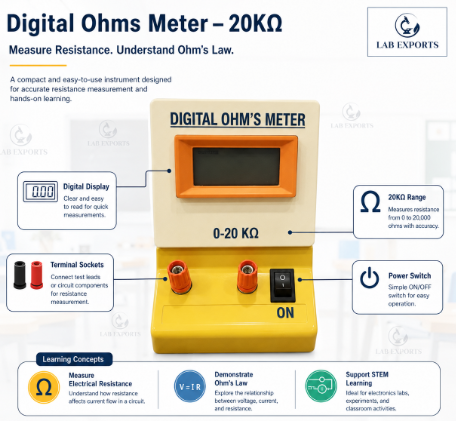
This digital ohms meter reads electrical resistance directly as a number, up to 20 kΩ (20,000 ohms). It is a dedicated resistance meter for checking resistors, coils and lengths of wire in physics and basic electronics practicals. The part under test must be disconnected from every power source before it is measured.
Specifications of the digital ohms meter
| Component | Specification |
|---|---|
| Instrument type | Digital ohmmeter |
| Measured quantity | Electrical resistance |
| Range | Up to 20 kΩ (20,000 ohms) |
| Display | Digital, direct numerical reading |
| House code | SCL-LM-11116 |
| Manufacturer | Lab Exports, Delhi |
Resistance checks with the digital ohmmeter
Disconnect the part from all power, connect it across the meter terminals and read the value from the display.
- Series and parallel. Measure two resistance coils one at a time as R1 and R2. Join them in series and read again, then in parallel. Compare the readings with R = R1 + R2 and 1/R = 1/R1 + 1/R2.
- Material and resistance. Cut equal lengths of constantan wire, manganin wire and nichrome wire of the same diameter, long enough to give a clear reading, and read each one. The readings differ because each alloy has its own resistivity.
- Colour code check. Read the value of a carbon resistor from its colour bands, then measure it. Work out the difference as a percentage of the marked value and see whether it lies within the tolerance band.
Frequently Asked Questions
Which range should be used for measuring resistance?
Use a range just above the resistance you expect; a range set too high wastes digits, and one set too low overloads. This meter reads up to 20 kΩ, which covers many resistors, coils and wire samples used in practicals. Much higher values need a meter with a wider range.
What specifications should be checked when buying a digital ohm meter?
Check the resistance range, the resolution of the display, the accuracy and the power source. For very low resistances, check whether the meter uses a four-wire connection to cancel lead resistance. For student work, a clear direct reading and a range covering the parts to be tested come first.
How should an ohmmeter be connected into an electrical circuit?
It should not be connected into a working circuit at all. Switch off and take the part out, or at least lift one end, then connect it across the meter terminals. Otherwise other parts in parallel change the reading, and any supply voltage can damage the meter.
Why should the metal probe tips not be held while measuring?
Holding both tips puts the resistance of your body in parallel with the part being measured. For a high resistance this lowers the reading noticeably. Hold the insulated part of the leads, or clip them on, and keep your fingers off the metal.
How are ohms measured?
An ohmmeter passes a small test current from its own internal source through the part and senses the voltage across it. The resistance is the ratio R = V/I, and this digital meter shows the value directly as a number.
Resistances and a bridge for ohmmeter practicals
- Resistance Box Plug Type
- Meter Bridge or Wheatstone Bridge With Pencil Jockey
- Rheostat Nichrome Wire Groove Type
More apparatus is in the Lab Meters section of the Physics Lab range.
To enquire, email [email protected] with the house code SCL-LM-11116 and the quantity, or use the Add To Cart button on this page.
Last updated: 24 November 2026