Anemometer Model
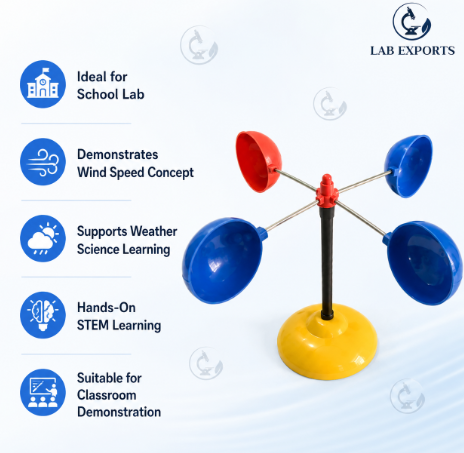
Product Code : SCL-LM-11118
This anemometer model is a cup anemometer of the Robinson type, made to show students how wind speed is measured. Hemispherical cups on horizontal arms turn a vertical spindle on a low-friction pivot, so the rotor responds even to gentle air currents. It is fully mechanical and needs no power.
Specifications of the anemometer model
| Component | Specification |
|---|---|
| Design | Rotational cup anemometer (Robinson type) |
| Rotor | Hemispherical cups on horizontal arms around a central vertical axis |
| Pivot | Low-friction, responds to gentle air currents |
| Mounting | On a base, for bench or outdoor use |
| Power | None, fully mechanical |
| Supplied | Fully assembled, with an instructional guide on wind speed calculation |
| House code | SCL-LM-11118 |
| Manufacturer | Lab Exports, Delhi |
Wind speed lessons with the anemometer model
Wind presses harder on the hollow face of a cup than on the rounded back of the cup opposite, so the rotor turns faster in a stronger wind. Let N be the rotation rate in turns per minute, and r the distance from the spindle to the centre of a cup. The cup speed is then v = 2πrN/60.
- A table fan as the wind. Set the model in front of a table fan. Mark one cup and count its turns for one minute, timed on the Analog Stop Clock. Repeat at each fan setting and work out v for each.
- Wind around the school. Take the model outdoors with a wind vane. Record the wind direction and the cup speed at several places, such as an open ground and a sheltered corner, and compare them.
- Moving air as energy. Place the anemometer and a windmill model in the same air stream. Both turn the energy of moving air into rotation, which leads into a lesson on wind power.
Frequently Asked Questions
What are the main types of anemometers?
The main types are cup, vane or propeller, hot-wire, ultrasonic and laser Doppler anemometers, and the Pitot tube is also used for air speed. Cup anemometers have cups spinning on a vertical axis and are common at weather stations. This model is a cup type of the Robinson pattern.
What should be checked when choosing a cup anemometer?
Check how gentle a wind starts it turning and the range of wind it can handle. Look at how sturdy it is outdoors, how it mounts and whether a calibration or conversion guide is included. This teaching model turns on a low-friction pivot, stands on a base and comes with a guide to wind speed calculation.
How do you calculate wind speed with a cup anemometer?
Count the turns of one marked cup over a timed minute to get N. Measure r from the spindle to the cup centre, then the cup speed is v = 2πrN/60. The cups move slower than the wind, so weather stations apply a calibration factor to get true wind speed.
Where should an anemometer be placed?
In open air, clear of walls, trees and buildings that block or swirl the wind, and on a level, steady base. Indoors, place it squarely in the air stream of a fan. Readings in sheltered spots come out lower, which shows students how obstacles slow the wind.
Other apparatus for wind and weather lessons
More apparatus is in the Lab Meters section of the Physics Lab range.
To enquire, email [email protected] with the house code SCL-LM-11118 and the quantity, or use the Add To Cart button on this page.
Last updated: 24 November 2026