Voltmeter
Product Code : EL-LM-10384
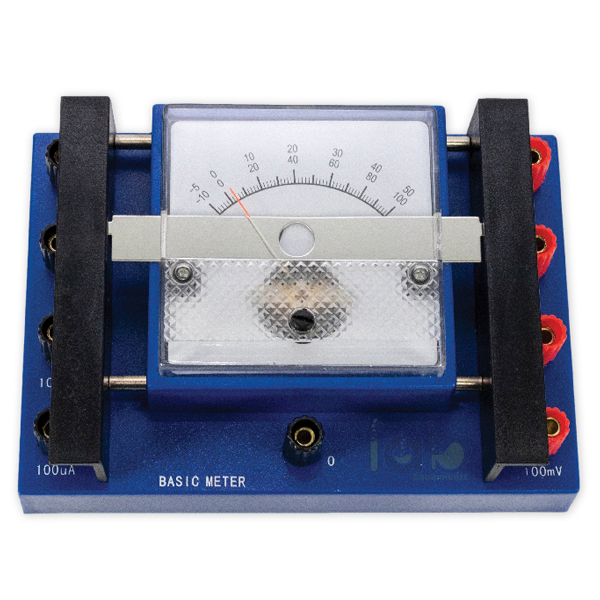
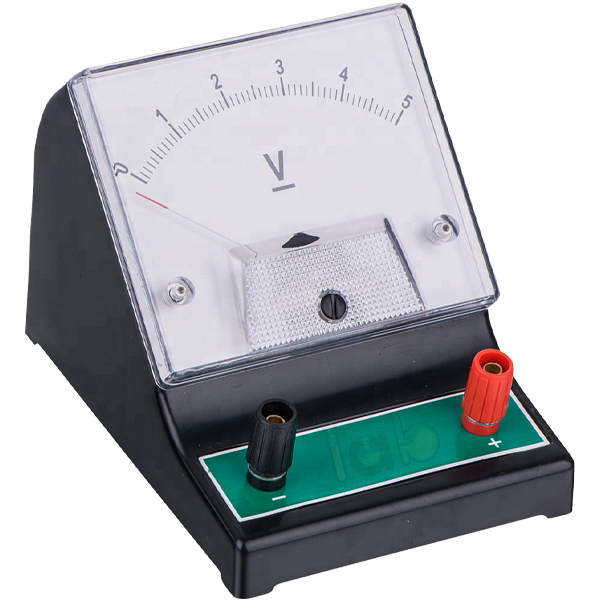
This analog moving-coil voltmeter measures the potential difference, or voltage, between two points in a circuit. It is joined across the component under test without breaking the circuit. The meter stands on a Bakelite or acrylic base with lock-type terminals, reads to ±2% F.S.D. and is made in all common ranges.
Specifications of the voltmeter
| Component | Specification |
|---|---|
| Type | Analog moving-coil voltmeter |
| Measures | Potential difference (voltage) between two points |
| Mounting | Bakelite or acrylic stand |
| Accuracy | ±2% F.S.D. |
| Terminals | Lock-type |
| Ranges | All common ranges |
| Packing | Card box |
| House code | EL-LM-10384 |
| Manufacturer | Lab Exports, Delhi |
Potential difference practicals with the voltmeter
The voltmeter leads go to the two ends of whatever is being tested, positive lead to the higher-potential side. Choose a range above the voltage expected and read the pointer square-on.
- Straight line or curve. Join a length of nichrome wire in series with an ammeter, a rheostat and a cell, with the voltmeter across the wire. Record V and I at several rheostat settings and plot V against I. The points for the wire lie on a straight line through the origin, so V is proportional to I. Repeat with a small torch bulb in place of the wire. Its graph curves, because the filament gets hotter as the current grows and its resistance rises.
- How much the voltmeter loads a circuit. Join two plug-type resistance boxes in series across a Leclanche cell, with a one-way plug key. Set both boxes to the same value, close the key and read across the pair, then across each box. With small values, each box shows about half the first reading. With large values, each shows less than half, because the voltmeter draws part of the current. The higher its resistance compared with the boxes, the smaller this error.
Documentation and supply
Most Lab Exports products carry a one-year manufacturer warranty.
Lab Exports manufactures the Voltmeter at its works in Laxmi Nagar, Delhi, and supplies it to schools, colleges and universities in India and 60+ countries, handling the export documents for each shipment. More about the company is on the About Lab Exports page.
Frequently Asked Questions
What are the two types of voltmeters?
Voltmeters are grouped by display, analog or digital, and by the kind of voltage they read, AC or DC. This one is an analog moving-coil meter with a pointer and scale. Before ordering, check the voltage type and the range needed for the practicals.
Which meter uses a moving coil?
Galvanometers and many analog ammeters and voltmeters use a permanent-magnet moving-coil movement. In a voltmeter the coil is joined in series with a high resistance, so it reads potential difference while taking only a small current from the circuit. This voltmeter has such a movement, rated at ±2% F.S.D.
What is the difference between a voltmeter and an ammeter?
A voltmeter measures potential difference and is joined in parallel, across a component. An ammeter measures current and is joined in series, in the path of the current. For this reason the voltmeter is built with a high resistance, and the ammeter with a very low one.
Can a voltmeter be used to measure emf?
Only approximately. A voltmeter across a cell draws a small current, so it reads the terminal potential difference, which is slightly less than the emf. The higher its resistance, the closer the reading comes. A potentiometer measures emf exactly because it draws no current at balance.
Apparatus for voltage and resistance practicals
More apparatus is in the Lab Meters section of the Physics Lab range.
To enquire, email [email protected] with the house code EL-LM-10384 and the quantity, or use the Add To Cart button on this page.
Last updated: 24 November 2026