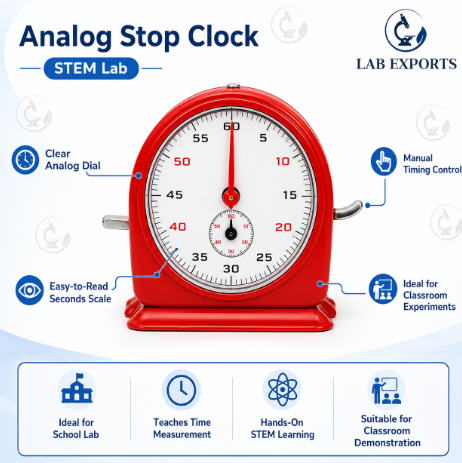
Analog Stop Clock
Product Code : SCL-LM-11103
This analog stop clock measures elapsed time in physics practicals and is read directly from its dial. It has start, stop and reset controls, so a run can be timed, recorded and repeated. Typical uses are timing pendulum oscillations, a body moving down an inclined plane and a liquid cooling through a set range.
Specifications of the analog stop clock
| Component | Specification |
|---|---|
| Display | Analog dial, read directly |
| Controls | Start, stop and reset |
| Measures | Elapsed time in laboratory practicals |
| Typical uses | Pendulum oscillations, motion on an inclined plane, cooling experiments |
| House code | SCL-LM-11103 |
| Manufacturer | Lab Exports, Delhi |
Timing experiments with the stop clock
Reset the clock to zero, start it at a clear reference event and stop it at the end of the run. Record the dial reading before resetting.
- Period of a simple pendulum. Tie a thread to one of the pendulum bobs and hang it from a rigid support. Start the clock as the bob passes its mean position and stop it after a counted number of oscillations. The period is the total time divided by that count.
- Motion down a slope. Time a body released from rest over a marked distance on the Inclined Plane Apparatus. Repeat at a steeper angle and compare the times.
Frequently Asked Questions
What is the difference between a stop clock and a stopwatch?
Mainly size and use. A stopwatch is small and handheld and is read close up by the person holding it. A stop clock is a larger bench timer with a bigger dial that a group can read, suited to longer runs in the lab. Both start, stop and reset.
What is the difference between a timer and a stopwatch?
A timer counts down from a set time and signals when it reaches zero. A stopwatch or stop clock counts up from zero to measure how long an event takes. This analog stop clock measures elapsed time, with start, stop and reset controls.
What is the least count of a stop clock?
It is the time shown by the smallest division on the dial. Take two numbered marks, find the time between them and divide by the count of small divisions in that gap. Work it out from the dial of your own clock before a practical.
How can reaction time error be reduced when timing a pendulum?
Time many oscillations in one run and divide by their number, so the small delay in pressing start and stop is shared over a long total time. Repeat the run and take the mean, and judge each crossing against a fixed marker.
Why is timing started as the bob passes the mean position?
The bob moves fastest at the mean position, so the moment it crosses a marker there is sharp and easy to judge. At the ends of the swing it slows down and seems to pause, which makes the turning instant hard to fix.
Other apparatus for timed practicals
More apparatus is in the Lab Meters section of the Physics Lab range.
To enquire, email [email protected] with the house code SCL-LM-11103 and the quantity, or use the Add To Cart button on this page.
Last updated: 24 November 2026