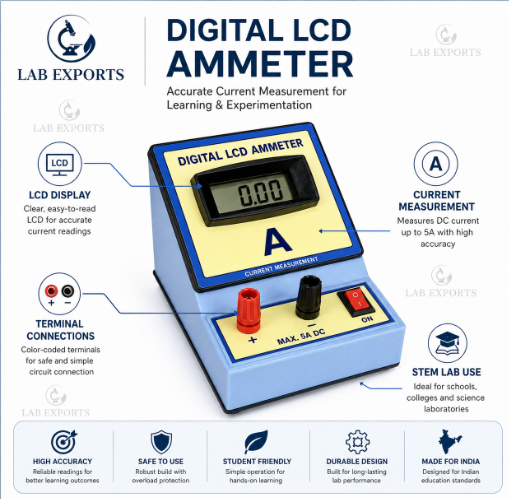
Digital LCD Ammeter
Product Code : SCL-LM-11096
This digital LCD ammeter is a bench-top meter for measuring current in DC circuit practicals. It is wired into the circuit in series, carrying the current it measures, and the value appears as a number on the LCD. Red and black terminals show the polarity, so students see at once which lead goes to the positive side.
Specifications of the digital LCD ammeter
| Component | Specification |
|---|---|
| Measured quantity | Electric current in DC circuits |
| Display | Digital LCD, read as a number |
| Terminals | Red and black, for polarity identification |
| Format | Bench-top meter |
| Supplied with | Installation instructions and a manual |
| House code | SCL-LM-11096 |
| Manufacturer | Lab Exports, Delhi |
Bench practicals with the LCD ammeter
The meter goes into a gap made in the circuit, with its red terminal on the side that leads back to the positive pole of the supply. Turn the supply off whenever a lead is moved.
- Lamp current at each supply step. Join the ammeter between a battery eliminator, set low, and the Lamps in Series Kit. Raise the voltage a step at a time, never past the input rating of the kit, and note the reading at every step. The current rises more slowly than the voltage, because hotter filaments have a higher resistance.
- Which end is north? Feed the coil of an electromagnet from the same supply through a rheostat, with the ammeter in the supply lead, and set a steady current. Find the north pole of the core with a plotting compass. Then swap only the two leads at the coil. The ammeter shows the same current, but the poles change ends.
Frequently Asked Questions
Should a school lab ammeter be AC or DC?
Choose it to match the supply used in the experiment. Most school circuit practicals are powered by dry cells or a battery eliminator, so they need a DC meter. This LCD ammeter is made for DC circuits. An AC circuit needs a meter rated for alternating current.
Can an ammeter damage a circuit?
Yes, if it is wired wrongly or overloaded. Joined across a cell or a component, it offers almost no resistance, so a heavy current flows that can burn out the meter, the leads or the supply. A current beyond the range of the meter can also damage it. Wiring it in series and checking the expected current first avoids both faults.
What precautions should be taken when using an ammeter in a practical?
Join it in series, with the red terminal towards the positive side, and check that the expected current is within its range before switching on. Close the plug key only while reading, so the wires do not heat up. Keep all connections clean and firm.
More items for DC current practicals
More apparatus is in the Lab Meters section of the Physics Lab range.
To enquire, email [email protected] with the house code SCL-LM-11096 and the quantity, or use the Add To Cart button on this page. Tender buyers can also see the Tenders and OEM page.
Last updated: 24 November 2026