Ohm Meter Shunt Type

Product Code : SCL-LM-11339
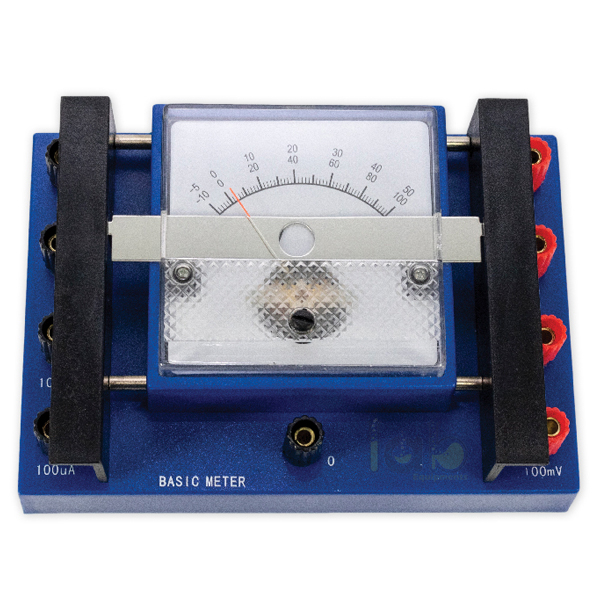
A shunt-type ohmmeter places the unknown resistance in a parallel branch of the measuring circuit. Changes in the test resistance alter current distribution and produce a corresponding meter indication. The apparatus helps students connect resistance theory with the operation of an analogue measuring instrument.
The Lab Exports model is intended for supervised educational experiments and instrument demonstrations. Its resistance range, meter movement, scale graduation, battery specification, adjustment controls, enclosure material and terminal arrangement must be confirmed from the approved product datasheet before publication or procurement.
Key Features
Shunt-circuit demonstration: Shows how an unknown resistance affects current in a parallel measuring branch.
Resistance measurement: Measures resistance within the specified laboratory .
Educational meter scale: Provides a resistance-calibrated indication.
Calibration control: Zero or reference adjustment arrangement .
Accessible connections: Uses designated test terminals or sockets .
Reusable training instrument: Supports repeated electrical measurement exercises without constructing the complete meter circuit each time.
Classroom application: Suitable for supervised physics, electrical engineering and vocational practicals.
Protective construction: Enclosure, fuse and current-limiting provisions .
Technical Specifications
|
Specification |
Detail |
|
Product name |
Ohm Meter Shunt Type |
|
Brand |
Lab Exports |
|
Instrument type |
Educational shunt-type resistance meter |
|
Measurement function |
Resistance measurement and shunt-ohmmeter demonstration |
Applications / Uses
Demonstrating the operating principle of a shunt-type ohmmeter.
Measuring compatible low resistance values.
Studying current division in a parallel circuit.
Observing the relationship between test resistance and meter deflection.
Practising instrument zeroing and resistance-scale interpretation.
Comparing measured resistors with their stated values.
How to Use the Ohm Meter Shunt Type
Place the apparatus on a dry and stable laboratory bench.
Inspect the test leads and confirm that the test circuit is not energised.
Select the required resistance range, where multiple ranges are provided.
Set the meter reference or zero control according to the approved manual.
Connect the unknown resistor across the designated test terminals.
Read the resistance value from the applicable scale.
Repeat the measurement with reference resistors to compare results.
Disconnect the resistor and switch off the apparatus after use.
Safety note: Never connect an ohmmeter to a live circuit. Discharge capacitors and isolate the component before taking a resistance measurement.
Care & Maintenance
Store the instrument in a dry cabinet away from dust, moisture and impact.
Clean the meter window, panel and terminals with a soft, dry cloth.
Inspect the leads and internal battery periodically and replace damaged or depleted parts with approved equivalents.
Do not force adjustment controls or subject the meter movement to mechanical shock.
Why Choose Lab Exports
Lab Exports manufactures, supplies and exports scientific and educational laboratory equipment for institutional users, recognised as a reliable test and measuring instrument India source with regular shipments to the Central African Republic (Central Africa), Indonesia (Southeast Asia) and Argentina (South America). Its portfolio includes physics instruments, laboratory meters, electrical experiment apparatus, science kits and STEM teaching equipment. The company supports OEM and international procurement requirements. Buyers should request the model-specific datasheet, packing list and compliance documents before ordering.
Frequently Asked Questions
What is an Ohm Meter Shunt Type used for?
It is used to measure resistance and demonstrate the operation of a shunt-connected ohmmeter circuit.
How does a shunt-type ohmmeter work?
The unknown resistance forms a parallel path in the meter circuit. Its value changes the current distribution and therefore the meter indication.
Is a shunt ohmmeter suitable for low resistance measurement?
Shunt-type circuits are commonly used to demonstrate lower resistance measurement. The usable range of this model must be confirmed.
Can it test resistance in a powered circuit?
No. The circuit must be isolated from all external power before resistance is measured.
Is the apparatus suitable for schools?
Yes. It is suitable for supervised electrical measurement experiments in schools, colleges, polytechnics and vocational laboratories.
What should buyers confirm before ordering?
Confirm the resistance range, scale, meter movement, power source, terminals, supplied leads, dimensions, product code and compliance documentation.
Request the verified specification sheet from Lab Exports or explore the physics laboratory meters range, electrical and electronics laboratory equipment, and the broader physics laboratory equipment collection.