Panel Meters

Product Code : EL-LM-10381
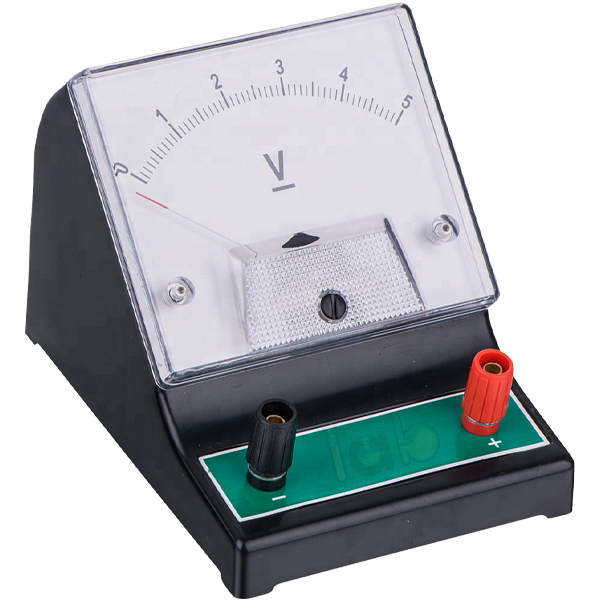
These moving-coil panel meters fit into a cut-out in an instrument panel, trainer or demonstration board and show current or voltage there. Four variants differ in case, scale and size. Cases are clear or black ABS, scales run from about 50 to 85 mm, and face sizes from 65 x 65 mm to 80 x 100 mm. Every variant has a knife-edge pointer and an accuracy of ±2% F.S.D.
Specifications of the panel meters
| Component | Specification |
|---|---|
| Movement | Moving coil, all variants |
| Pointer | Knife-edge, all variants |
| Accuracy | ±2% F.S.D., all variants |
| Variant 1 | Clear transparent case, white ABS base; scale about 50 mm; 65 x 65 mm square |
| Variant 2 | Moulded black ABS case; scale about 50 mm; 80 mm round |
| Variant 3 | Clear transparent case, white ABS base; scale about 60 mm with anti-parallax mirror; 80 x 80 mm square |
| Variant 4 | Black ABS case with clear front window; scale about 85 mm; 80 x 100 mm |
| When ordering | Quote the variant number and the current or voltage range required |
| House code | EL-LM-10381 |
| Manufacturer | Lab Exports, Delhi |
Building panel meters into boards and trainers
A panel meter stays fixed in one place and shows a single quantity all the time. The body passes through a cut-out in the panel, and the wiring is done behind the panel.
- A meter on a project board. Fit a panel ammeter in a student-built board fed from a Battery Eliminator, with a rheostat in series. As the rheostat is moved, the class watches the current change on the fixed meter.
- Short scale or long scale. Fit a 50 mm variant and the 85 mm variant, both ordered with the same range, side by side on a board. Join them in series with a Resistance Box Plug Type and a low-voltage supply, so both carry the same current. Start from a high box value so that the current stays within range. Students read both meters at a few settings and find that the longer scale can be read to finer divisions.
Frequently Asked Questions
How do you choose the size of an analog panel meter?
Match the face and the cut-out to the space on the panel, and pick a larger face when it must be read from further away. Check the depth behind the panel too. Here the choice is 65 x 65 mm, 80 mm round, 80 x 80 mm or 80 x 100 mm, with scales of about 50 to 85 mm.
What is the most common analog meter movement?
The permanent-magnet moving coil is the most common analog meter movement. It gives an evenly spaced scale and draws very little power from the circuit. All four variants in this range use a moving-coil movement with a knife-edge pointer.
How does an analog panel meter work?
Current through a small coil, pivoted in the field of a permanent magnet, makes the coil turn. Spiral springs resist the turn, so the coil settles where the two torques balance and the pointer shows the value. When the current stops, the springs return the pointer to zero.
What is the difference between a shunt and a multiplier?
A shunt is a low resistance joined in parallel with the meter movement, so it can read larger currents as an ammeter. A multiplier is a high resistance joined in series with the movement, so it can read voltage as a voltmeter. The panel meter range depends on which is fitted.
Items for panel and trainer building
More apparatus is in the Lab Meters section of the Physics Lab range.
To enquire, email [email protected] with the house code EL-LM-10381 and the quantity, or use the Add To Cart button on this page.
Last updated: 24 November 2026