Solar Irradiance Meter
Product Code : SCL-EAE-11348
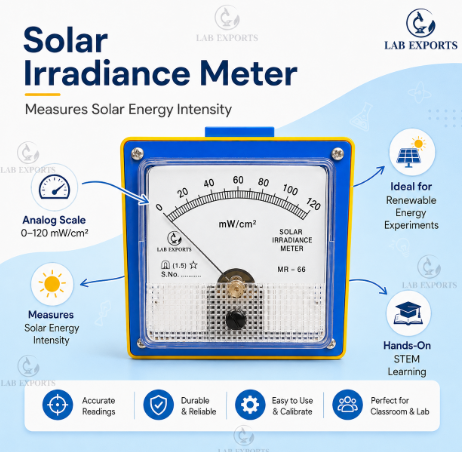
This instrument measures solar irradiance, the power of sunlight arriving on each square metre of a surface, commonly expressed in watts per square metre. In photovoltaic work it records the light a solar module actually receives, so output can be compared at different angles, times and places.
Specifications of the solar irradiance meter
| Component | Specification |
|---|---|
| Instrument | Single measurement instrument |
| Measured quantity | Incident solar irradiance |
| Unit | Commonly expressed in watts per square metre (W/m2) |
| Range, resolution and accuracy | Confirmed with the quotation |
| House code | SCL-EAE-11348 |
| Manufacturer | Lab Exports, Delhi |
Measurement tasks with the irradiance meter
Irradiance falls with cloud, haze, shade, the time of day and the angle between the surface and the sun. The meter turns each of these effects into a number that students can record and compare.
- Through the day. Choose one open spot and record the irradiance at set times from morning to afternoon. Plot the readings against time and mark where cloud passed.
- Efficiency of a solar cell. Set the sensor at the same tilt as the cell on the Solar Cell Characteristics Apparatus and find the maximum output power P of the cell. Efficiency = P/(G × A), where G is the irradiance and A is the area of the cell.
- Angle and output together. Tilt a solar module and the sensor together in steps. At each step read the irradiance and the module current on a Digital Multimeter, and plot one against the other.
Taking a reading
- Place the sensor at the spot to be tested, clear of shadows.
- Tilt the sensor to the same angle as the solar module under study.
- Allow the reading to settle, then record it.
- Repeat at other angles, times of day or places and compare the values.
Documentation and supply
Most Lab Exports products carry a one-year manufacturer warranty.
Lab Exports manufactures the Solar Irradiance Meter at its works in Laxmi Nagar, Delhi, and supplies it to schools, colleges and universities in India and 60+ countries, handling the export documents for each shipment. More about the company is on the About Lab Exports page.
Frequently Asked Questions
What is a good solar irradiance?
Near midday on a clear day, irradiance at ground level approaches about 1000 W/m2. Cloud, haze, shade, an early or late hour and a poor angle all lower it. Readings far below this mean less light is reaching the surface.
How do you measure solar irradiance?
Place the sensor where the light is to be measured, clear of shadows, and tilt it to the angle of the surface or module under study. Let the reading settle and record it, then repeat at other angles, times or places.
Can a lux meter be used instead of a solar irradiance meter?
Not for solar work. A lux meter weights light by the sensitivity of the human eye and reads in lux. A solar irradiance meter reads the power of sunlight in W/m2, which is what a solar cell responds to. There is no fixed conversion between the two.
How do I know if a place gets enough sun for solar panels?
Measure the irradiance there at several times of day, with the sensor at the planned panel tilt. Compare the values with readings from a fully open site nearby. Low or patchy values point to shade or a poor angle.
Apparatus for measuring solar cell output
More apparatus is in the Electrical and Electronics section of the Physics Lab range.
To enquire, email [email protected] with the house code SCL-EAE-11348 and the quantity, or use the Add To Cart button on this page.
Last updated: 23 November 2026