Digital Panel Meter
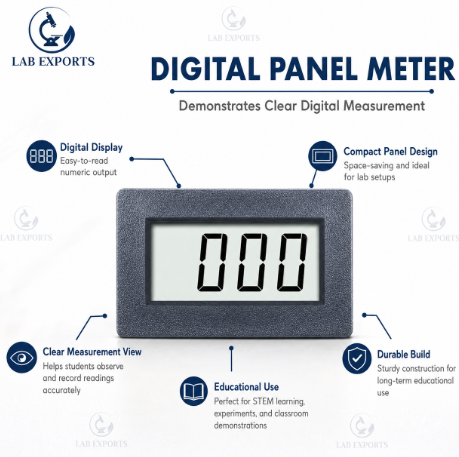
Product Code : SCL-EAE-11204
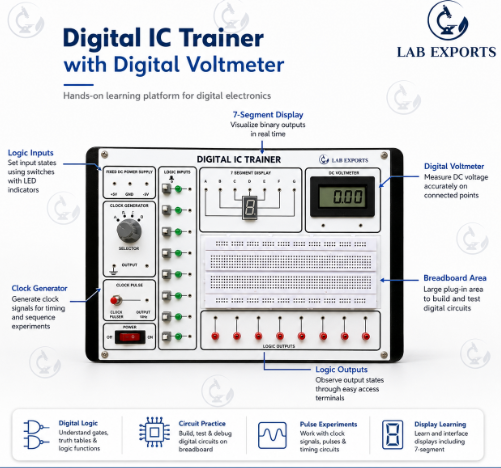
This panel-mounting meter shows one selected electrical quantity, such as voltage or current, as a number on a digital display. It is built into circuit trainers, power-supply panels and demonstration boards, so students read values directly instead of judging a pointer on a scale. It has a 3½-digit LCD, runs from a 9 V auxiliary supply and fits a 68 x 33 mm cut-out.
Specifications of the digital panel meter
| Component | Specification |
|---|---|
| Type | Digital panel-mounting meter; each version measures one specified quantity |
| Display | 3½-digit LCD, ±1999 counts |
| Basic input | 200 mV DC |
| DC voltage ranges | 200 mV; 2 V or 20 V through input dividers |
| DC current ranges | 20 mA or 200 mA, through shunts |
| Other versions | Resistance, 0 to 2 kΩ, with excitation; frequency, 0 to 2 kHz, with pulse-input circuitry |
| Auxiliary supply | 9 V nominal |
| Panel cut-out | 68 x 33 mm |
| Connections | Integrated display with input and supply terminals |
| Model choice | Fixed by the quantity and range stated when enquiring |
| House code | SCL-EAE-11204 |
| Manufacturer | Lab Exports, Delhi |
Where the panel meter is used
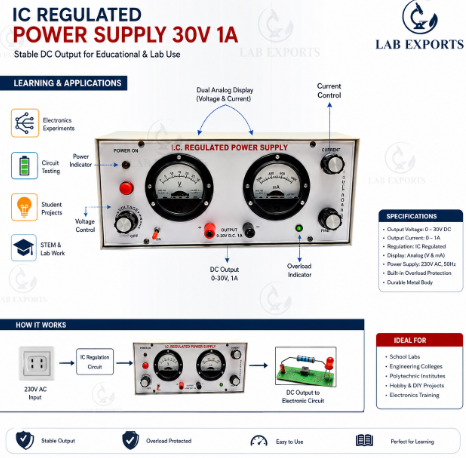
- Power-supply output. Fitted in a supply panel, it shows the output voltage or current all the time while students set the supply.
- Step-by-step readings. In a V-I practical, such as on the Ohms Law Apparatus, each digital reading goes straight into the observation table as the voltage is raised.
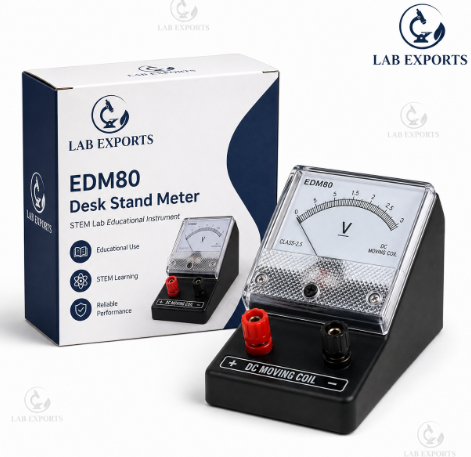
- Digital against analogue. Set it beside an analogue voltmeter panel to show students how a direct number avoids the parallax of a pointer scale.
- Cross-checks. Compare its reading with a digital multimeter when a trainer panel is first wired.
Fitting the meter
- Choose the model for the quantity and range required.
- Mount the meter in a 68 x 33 mm panel cut-out in the trainer or power-supply unit.
- Wire the input terminals and the 9 V supply terminals as shown in the connection diagram supplied with the meter.
- Switch on and check the reading against a known source before using it in practicals.
Frequently Asked Questions
What is a digital panel meter used for?
It gives a continuous digital reading of one circuit quantity on an instrument panel. In the lab it is built into circuit trainers, power-supply units and demonstration panels, so students can record voltage, current or another value directly.
What should be stated when choosing a digital panel meter?
State the quantity and the range: 200 mV, 2 V or 20 V DC; 20 mA or 200 mA; 0 to 2 kΩ; or 0 to 2 kHz. These fix the version supplied, so give them when you email [email protected] with house code SCL-EAE-11204.
Does a digital panel meter need its own power supply?
Yes. It needs a 9 V nominal auxiliary supply on its supply terminals, separate from the input it measures. Wire the supply and the input as the connection diagram shows.
What are the advantages of digital meters over analogue meters?
A digital meter shows the value as digits, so there is no parallax and no guessing between scale marks. Readings are quick to take and to copy into an observation table, even for students new to meters.
Is an analogue or a digital meter better?
It depends on the job. A digital meter suits exact readings recorded step by step. An analogue pointer shows a rising or falling value at a glance and picks up less electrical noise, so many labs keep both.
Other meters for lab panels and benches
- Panel Meters
- Analog Ammeter Panel
- Analog Voltmeter Panel Type
- Digital LCD Ammeter
- Digital Multimeter
More apparatus is in the Electrical and Electronics section of the Physics Lab range.
To enquire, email [email protected] with the house code SCL-EAE-11204 and the quantity, or use the Add To Cart button on this page.
Last updated: 23 November 2026