Play with Lights Kit
Product Code : SCL-LAO-11106
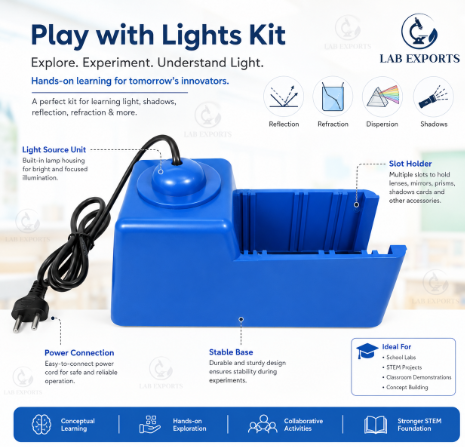
The Play with Lights Kit is a first optics kit for early learners in the school science classroom. Through hands-on activities, pupils explore how light behaves, how it reflects from shiny surfaces and how colours appear. Inside are a low-voltage LED ray source for two AA cells, a plane mirror with a stand, red, green and blue filters, a translucent screen and activity cards.
Specifications of the play with lights kit
| Component | Specification |
|---|---|
| Type | Introductory light and optics activity kit |
| Topics covered | Basic behaviour of light, reflection and colour |
| Level | Early learners meeting optics for the first time |
| Setting | School science classroom, hands-on group activities |
| Light source | Low-voltage LED ray source, runs on two AA cells |
| Mirror | Plane mirror with stand |
| Colour filters | Red, green and blue |
| Screen | Translucent |
| Activity cards | Included |
| House code | SCL-LAO-11106 |
| Manufacturer | Lab Exports, Delhi |
First light lessons around the kit
Young pupils learn most when they see light do something and then put it into words. Each lesson can start with one question, let small groups try it, and end with a simple drawing of where the light went.
- Light travels in straight lines. In a dimmed room, the LED ray source of the kit shines onto the translucent screen. Pupils hold up a card and a hand in the light and watch the shadow change shape and size as they move closer to the source.
- Bounce the light to a target. Pupils tilt the plane mirror on its stand to send a patch of light onto a paper target on the wall. They soon find that turning the mirror moves the patch, so the reflected light has a direction they can control.
- Colours hidden in white light. With the teacher holding a Prism Glass in a beam of light, a band of colours appears on a white wall. Pupils name the colours in order and learn that white light contains all of them. Then they hold the red, green and blue filters in the light in turn. Each filter removes the other colours from the white light and lets its own colour through. This filtering is different from adding coloured lights together, as on the Primary Colour Kit.
- See-through or not? Pupils sort everyday materials such as glass, tracing paper and card by how much light they let through, and test each guess against the light. The translucent screen of the kit is a good example to start from.
Frequently Asked Questions
What is usually included in a light activity kit for kids?
It depends on what the kit teaches. Light and optics kits for young pupils usually hold a light source with its power parts, some mirrors, lenses or colour sheets, and an activity guide. This kit holds an LED ray source that runs on two AA cells, a plane mirror with a stand, red, green and blue filters, a translucent screen and activity cards.
How is an optics light kit different from a light circuit kit?
A circuit kit, with a cell, bulb, switch and wires, teaches how a bulb is made to glow. An optics kit teaches what light does after it leaves the source: how it travels, reflects and shows colour. The Play with Lights Kit is the optics type.
What are some basic questions about light for young pupils?
Start with where light comes from, how it travels and what happens when it meets an object. Good first questions are why shadows form, where light goes when it meets a mirror, and why a prism or a soap bubble shows colours.
What are some activities for students to learn about the reflection of light?
Simple ones work well. Pupils can compare how shiny and dull surfaces reflect light. They can also look at their own image to see that it looks reversed left to right.
What is the difference between transparent, translucent and opaque materials?
A transparent material, such as clear glass, lets light through so you can see clearly through it. A translucent one, such as tracing paper, lets light through but scatters it, so shapes look blurred. An opaque one, such as card, blocks the light and casts a shadow.
Other aids for early light lessons
More apparatus is in the Light and Optics section of the Physics Lab range.
To enquire, email [email protected] with the house code SCL-LAO-11106 and the quantity, or use the Add To Cart button on this page.
Last updated: 28 November 2026