Galvanometer
Product Code : EL-LM-10382
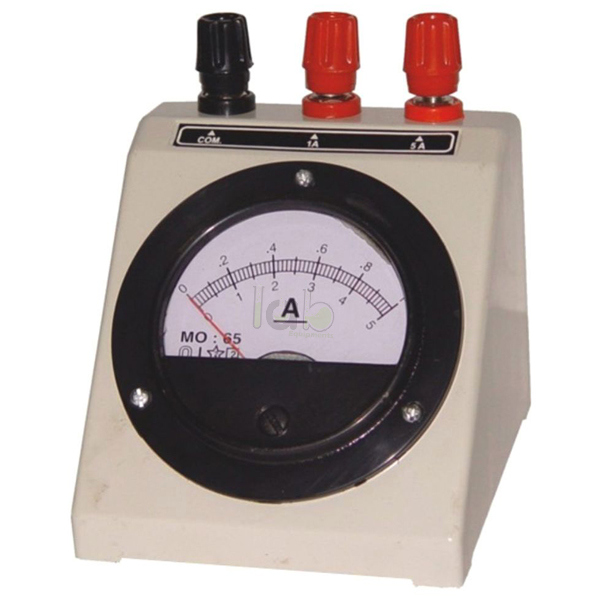
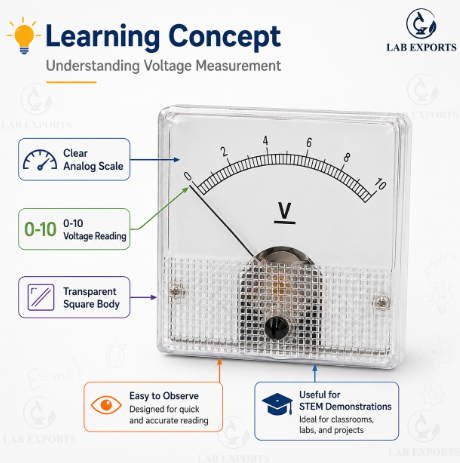
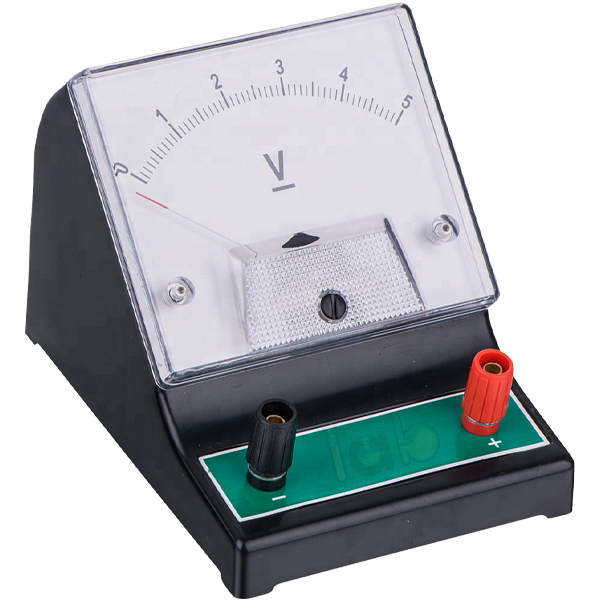
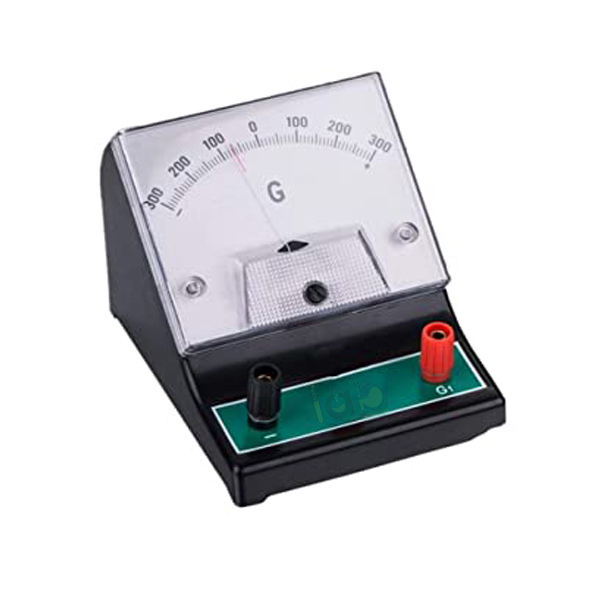
This analog moving-coil galvanometer is a bench meter for detecting and measuring small direct currents. Its accuracy is ±2% of full-scale deflection (F.S.D.). The movement sits on a Bakelite or acrylic stand with lock-type terminals, and the meter is made in all common ranges.
Specifications of the moving-coil galvanometer
| Component | Specification |
|---|---|
| Type | Analog moving-coil galvanometer / ammeter |
| Measures | Small direct currents |
| Accuracy | ±2% F.S.D. |
| Mounting | Bakelite or acrylic stand |
| Terminals | Lock-type |
| Ranges | All common ranges |
| Packing | Card box |
| House code | EL-LM-10382 |
| Manufacturer | Lab Exports, Delhi |
Measuring and converting with this galvanometer
Current in the coil, which hangs in a radial magnetic field, makes a torque that turns it against a control spring. The pointer deflection is therefore proportional to the current. Two values describe the meter: G, the resistance of its coil, and Ig, the current that gives full-scale deflection.
- Conversion into an ammeter. Join a low resistance S, the shunt, in parallel with the galvanometer. For a new range of 0 to I, S = IgG/(I - Ig). A short length of constantan wire makes a steady shunt. Check the converted meter in series with a standard ammeter, using a rheostat to vary the current.
- Conversion into a voltmeter. Join a high resistance R in series with the galvanometer. For a range of 0 to V, R = V/Ig - G. Take R from a plug-type resistance box. Then connect the converted meter and a standard voltmeter across the same test resistor, and compare their readings.
- Null detector in a bridge. In the meter bridge, the galvanometer joins the centre terminal to the jockey. The bridge is balanced at the point where it shows no deflection.
Frequently Asked Questions
What does an accuracy of ±2% F.S.D. mean?
Any reading may be off by up to 2% of the full-scale value, not 2% of the reading itself. The possible error is the same size all along the scale. So readings in the upper part of the scale carry the smallest percentage error. Choose a range in which your currents give a large deflection.
Can this galvanometer measure alternating current?
No. A moving-coil movement responds to direct current. With AC, the torque reverses every half cycle, so the pointer only trembles near zero and its average reading is zero. Use it on DC circuits, fed by a cell or a battery eliminator.
Why does the converted ammeter have a low resistance and the voltmeter a high one?
An ammeter goes in series, so it must add very little resistance to the circuit. The shunt carries most of the current and keeps the total resistance low. A voltmeter goes across a component, so it must draw very little current. The high series resistance makes sure of that.
What is the figure of merit of a galvanometer?
It is the current needed to move the pointer by one scale division, in amperes per division. A smaller figure of merit means a more sensitive meter. Its inverse, divisions per ampere, is called the current sensitivity. Both are found by passing a known small current and counting the divisions.
Why is the scale of a moving-coil galvanometer evenly divided?
The coil turns in a radial magnetic field, so the turning torque depends only on the current, at every angle. The control spring pushes back in proportion to the angle turned. Deflection is therefore proportional to current, and equal steps of current move the pointer equal distances.
Other galvanometers
- Galvanometer, listed for null detection in bridge and potentiometer work
- Galvanometer EDSPOT
- Ballistic Galvanometer
- Tangent Galvanometer
More meters are in the Lab Meters section of the Physics Lab range.
To enquire, email [email protected] with the house code EL-LM-10382 and the quantity, or use the Add To Cart button on this page. Tender buyers can also see the Tenders and OEM page.
Last updated: 19 November 2026