Optical Bench Full Shaper
Product Code : SCL-LAO-11180
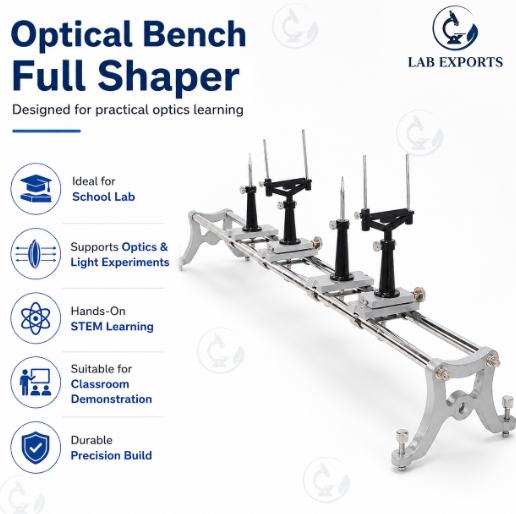
The Optical Bench Full Shaper is a reinforced metal rail with an engraved, dual-graduated scale marked at 1 mm intervals. Four adjustable riders lock in place with fine-threaded thumbscrews. Two spring-loaded co-axial holders take lenses and mirrors, and a translucent object screen with a centred target grid serves as the object. The bench length is confirmed in the quotation.
Specifications of the full shaper optical bench
| Component | Specification |
|---|---|
| Rail | Reinforced metal rail, full shaper profile, made to resist bowing or twisting |
| Scale | Engraved, dual-graduated, 1 mm intervals |
| Riders | 4, adjustable, locking with fine-threaded thumbscrews |
| Lens and mirror holders | 2, spring-loaded, co-axial |
| Object screen | 1, translucent, with a centred target grid |
| Supplied with | User manual with guided experiments |
| Bench length | Confirmed in the quotation; state the length required when asking |
| House code | SCL-LAO-11180 |
| Manufacturer | Lab Exports, Delhi |
Measurements with the lit grid object
Set the bench on a level table and fit the riders. Light the translucent object screen from behind, for example with a Rectangular Lamp House, so that its target grid becomes the object. Lock each rider before reading its position on the 1 mm scale.
- The lens formula over a long range. Mount a Convex Lens in one holder with its centre at the height of the grid centre. Set the object screen at several distances spread along the rail. For each one, slide a White Screen Wooden until the grid lines look sharp, then lock it and read the scale. Take u as the object distance and v as the image distance, both from the lens, with u negative for a real object. The value of 1/v - 1/u should stay nearly the same for every pair, and it equals 1/f, where f is the focal length.
- Displacement method. Fix the object screen and the White Screen Wooden a distance D apart, with D greater than 4f. Move the lens between them and find the two positions that give a sharp image. If d is the distance between those two lens positions, then f = (D2 - d2)/4D. This method needs no measurement from the optical centre of the lens.
- Leaving a set-up for a group. Because the riders lock, one arrangement can stay untouched while several students sight the image and read the scale in turn. Their spread of readings shows how repeatable the result is.
Frequently Asked Questions
What should be checked in the riders of an optical bench?
The riders should slide smoothly without wobbling, lock firmly and keep the optical centres on one axis. On this bench the four riders lock with fine-threaded thumbscrews, and the two spring-loaded holders are co-axial.
How long should an optical bench be?
It should be long enough for the focal lengths you use and for every part in the set-up. The displacement method, for example, needs object and screen more than four focal lengths apart. The length of this bench is confirmed in the quotation, so state the length required when you ask.
How do you minimise errors on an optical bench?
Keep the centres of the object, lens and screen on one horizontal line. Lock each rider before reading, look straight down on the scale mark to avoid parallax, and average several readings.
What is the lens formula?
The lens formula is 1/f = 1/v - 1/u. Here f is the focal length, u is the object distance and v is the image distance, and all three are counted from the optical centre. With the usual sign convention, u is negative for a real object.
More apparatus is in the Light and Optics section of the Physics Lab range.
To enquire, email [email protected] with the house code SCL-LAO-11180 and the quantity, or use the Add To Cart button on this page. Tender buyers can also see the Tenders and OEM page.
Last updated: 28 November 2026