Angle Between Mirrors
Product Code : SCL-LAO-11108
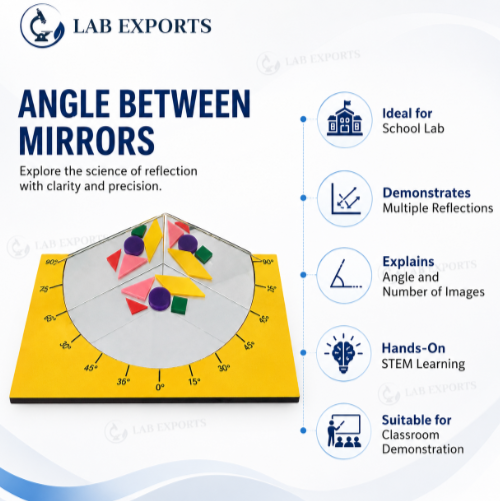
Quick answer: The Angle Between Mirrors model shows multiple image formation by two inclined plane mirrors. Students set the mirrors at angles such as 90, 60 or 45 degrees, place an object between them and count the images, then compare the count with n = 360/theta - 1. Lab Exports manufactures it in Delhi for schools, colleges and universities.
Specifications
| Parameter | Detail |
|---|---|
| Type | Demonstration apparatus with two plane mirrors |
| Primary use | Multiple image formation between inclined plane mirrors |
| Typical angles | 90, 60 and 45 degrees, or other selected angles |
| Quantity | Single classroom demonstration set |
How the experiment is done
When two plane mirrors meet at an angle, light from an object reflects from one mirror to the other and back several times before reaching the eye, and each sequence of reflections produces a separate image. The images lie on a circle centred on the line where the mirrors meet, and the smaller the angle, the more images appear.
When 360/theta is an even number, the number of images is n = 360/theta - 1. At 90 degrees three images are seen, at 60 degrees five, and at 45 degrees seven. As the mirrors approach parallel the count grows very large, which is the effect seen between facing mirrors in a lift or salon.
- Place the model on a stable laboratory table.
- Set the two mirrors at the chosen angle, for example 90 degrees.
- Place a small object, such as a pin or coloured bead, between the mirrors near the bisector of the angle.
- Count the images seen in the mirrors.
- Change the angle to 60 and 45 degrees and repeat, comparing the counts with the formula.
Handle the mirrors carefully, avoid pressing on the reflecting surface, and do not use a cracked mirror in student work.
Key features
- Two plane mirrors that can be set at a selected angle.
- Shows the link between mirror angle and number of images.
- Supports reflection, symmetry and geometrical optics lessons.
- Easy to set up and repeat during practical sessions.
- Connects physics with geometry and angle measurement.
Documentation and supply
Most Lab Exports products carry a one-year manufacturer warranty.
Lab Exports manufactures the angle between mirrors model at its works in Laxmi Nagar, Delhi, and supplies it to schools, colleges and universities in India and 60+ countries, handling the export documents for each shipment. More about the company is on the About Lab Exports page.
Related Light and Optics products
- Phenakistoscope Model (SCL-LAO-11107)
- Play with Lights Kit (SCL-LAO-11106)
- Rectangular Lamp House (SCL-LAO-11110)
- White Screen Wooden (SCL-LAO-11111)
- Reflection of Light Kit (SCL-LAO-11104)
- Plastic Lens Holder (SCL-LAO-11102)
The full range is in the Light and Optics section of the Physics Lab range.
Frequently asked questions
How many images are formed by two mirrors at 60 degrees?
Using n = 360/theta - 1, two plane mirrors at 60 degrees form five images of an object placed between them.
What does the angle between mirrors model demonstrate?
It demonstrates multiple image formation by inclined plane mirrors and how the number of images increases as the angle between the mirrors decreases.
What is the price of the angle between mirrors model?
Prices are not published on the website. Add the angle between mirrors model to the Enquiry Cart with the Add To Cart button on this page, or email [email protected] with the house code SCL-LAO-11108 and the quantity, to receive a quotation.
Does Lab Exports manufacture the angle between mirrors model?
Yes. Lab Exports manufactures the angle between mirrors model at its works at 11/315, Lalita Park, Laxmi Nagar, Delhi 110092, under house code SCL-LAO-11108.
Request a quote
Email [email protected] with the house code SCL-LAO-11108 and the quantity, or add the angle between mirrors model to the Enquiry Cart with the Add To Cart button on this page. Tender buyers can also see the Tenders and OEM page.