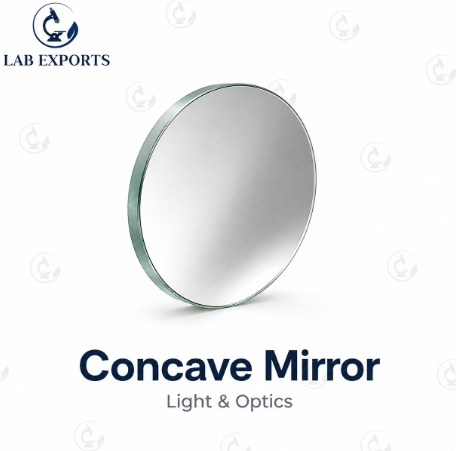
Concave Mirror
Product Code : SCL-LAO-11236
A concave mirror is a converging spherical mirror. Its inward-curved reflecting surface brings parallel rays to a principal focus in front of it. Students use it to find focal length, catch real images on a screen and see an upright, magnified virtual image. It comes in 50 mm and 75 mm nominal diameters.
Specifications of the concave mirror
| Component | Specification |
|---|---|
| Mirror type | Concave (converging) spherical mirror |
| Diameters | 50 mm or 75 mm (nominal) |
| Concepts shown | Reflection, convergence, focal length, magnification, image formation |
| Supplied as | One mirror in the selected diameter |
| Radius of curvature, focal length and mounting | Confirmed with the quotation |
| House code | SCL-LAO-11236 |
| Manufacturer | Lab Exports, Delhi |
Experiments with the concave mirror
In the mirror formula 1/f = 1/v + 1/u, every distance is measured from the pole P, the centre of the reflecting face. Here u is measured to the object, v to the image and f to the principal focus. Under the New Cartesian convention a distance counts as positive along the incident light and negative against it. A real object and its real image both lie in front of a concave mirror, so u, v and f are all negative there.
The principal focus lies midway between P and the centre of curvature C. So f = R/2, with R, the radius of curvature, equal to the distance PC.
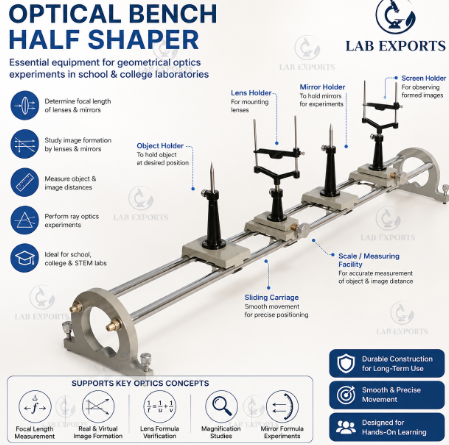
- Readings on both sides of C. On an Optical Bench Half Shaper, use an Optical Needle / Parallax as the object and a second needle to find its inverted image by parallax. With the object beyond C, the image forms between C and F. Move the object between C and F, and the image moves out beyond C. Record u and v at each setting, then find f from the mirror formula.
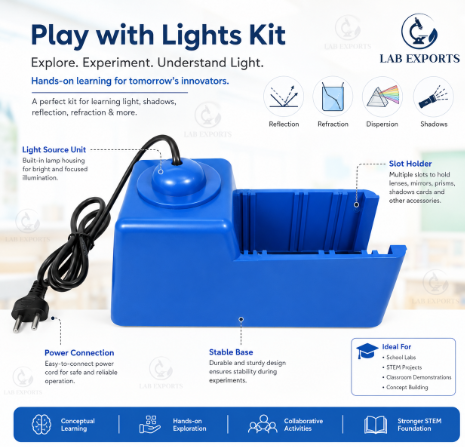
- What the image looks like. Use a Rectangular Lamp House as a bright object. A White Screen Wooden, set slightly to the side of the mirror axis, picks up each real image. Beyond C the image is inverted and diminished, and between C and F it is inverted and enlarged. Inside F the screen shows nothing, because the image is virtual.
Frequently Asked Questions
Which details matter when ordering a concave mirror for practicals?
Four points matter: focal length for the bench length, diameter for your holders, the reflecting surface with its protective backing, and whether a mount is needed. Its diameter is 50 mm or 75 mm, and its radius of curvature, focal length and mounting are confirmed with the quotation.
How can the focal length of a new concave mirror be checked before class?
Point it at a distant window or bright object and move a white screen until the image is sharp. The mirror-to-screen distance is close to the focal length, so compare it with the value in the quotation before the mirror goes into a practical.
Does the focal length of a concave mirror change in water?
No. A mirror works by reflection, and its focal length depends only on its curvature, f = R/2. A lens behaves differently: its focal length changes in water, because refraction depends on the refractive index of the surrounding medium.
What happens if the object needle is placed between the pole and the focus?
The mirror then forms a virtual, upright and magnified image behind it. No real image forms in front, so a screen cannot catch it and the usual readings in front of the mirror cannot be taken. Keep the object beyond F for measured readings.
Why are concave mirrors used in torches and headlights?
A lamp at the principal focus sends its light to the mirror, which reflects it as a nearly parallel beam. Such a beam spreads little, so it lights objects far ahead. Moving the lamp off the focus makes the beam spread or converge.
Apparatus for mirror practicals
More apparatus is in the Light and Optics section of the Physics Lab range.
To enquire, email [email protected] with the house code SCL-LAO-11236 and the quantity, or use the Add To Cart button on this page.
Last updated: 28 November 2026