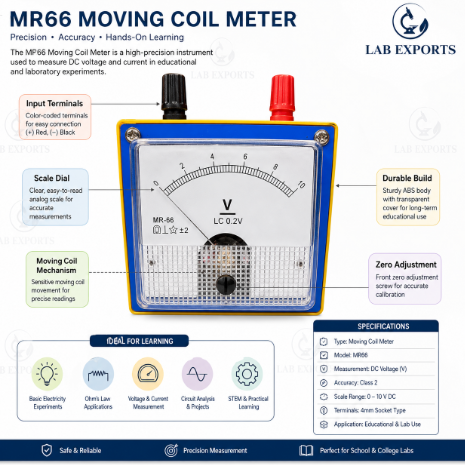
Analog Ammeter Panel

Product Code : SCL-LM-11151
This analog ammeter panel is a panel-type ammeter that shows current by a pointer moving over a graduated scale. It fits into teaching panels, demonstration boards and laboratory set-ups, so the reading stays beside the switches and terminals it belongs to. Like any ammeter, it is wired in series with the load.
Specifications of the analog ammeter panel
| Component | Specification |
|---|---|
| Instrument type | Panel-type analog ammeter |
| Measured quantity | Electric current |
| Display | Analog pointer with graduated scale |
| Mounting | For fitting into panels, demonstrators and laboratory set-ups |
| Connection | In series with the load |
| House code | SCL-LM-11151 |
| Manufacturer | Lab Exports, Delhi |
Building the panel ammeter into circuit boards
Choose a range above the highest current the board can draw, set the meter in its cut-out and wire it in series with the load. Both tasks below are for a DC meter, with its plus terminal wired towards the plus side of the supply.
- One meter, four loads. Join a different load to each way of a Four Way Plug Key, one of them a Resistance Box Plug Type set to a high value. Connect the supply, the meter and the key in series. Move the plug from way to way. The fixed meter shows the current each load draws, and the load with the least resistance draws the most.
- A supply panel that shows its load. Fit the meter beside the output terminals of a panel built round an IC regulated battery eliminator, in series with one output lead. Whatever circuit is plugged in, the panel shows the current it draws, so a circuit drawing too much is noticed at once.
Frequently Asked Questions
How is a shunt chosen for a DC panel ammeter?
Match the shunt to the meter: its millivolt drop at rated current must equal the full-scale input marked on the meter. Its current rating should sit above the normal load. Large shunts are mounted outside the panel. AC panel ammeters for heavy currents use a current transformer instead.
Why is a shunt resistor used in an ammeter?
It lets the meter read currents far larger than its moving coil can carry. The coil takes only a small current. A low-resistance shunt in parallel with it carries most of the circuit current, so only a fixed small share passes through the coil. The shunt also keeps the meter resistance low.
Why is an ammeter connected in series?
Because only a meter placed in the same path as the load carries the current that flows through it. In a series loop that current is the same at every point, so the meter can sit on either side of the load. On a panel it is wired into the lead that feeds the load.
Other items for panel and board circuits
More apparatus is in the Lab Meters section of the Physics Lab range.
To enquire, email [email protected] with the house code SCL-LM-11151 and the quantity, or use the Add To Cart button on this page.
Last updated: 24 November 2026