Newton's Ring Apparatus
Product Code : EL-LAO-10350
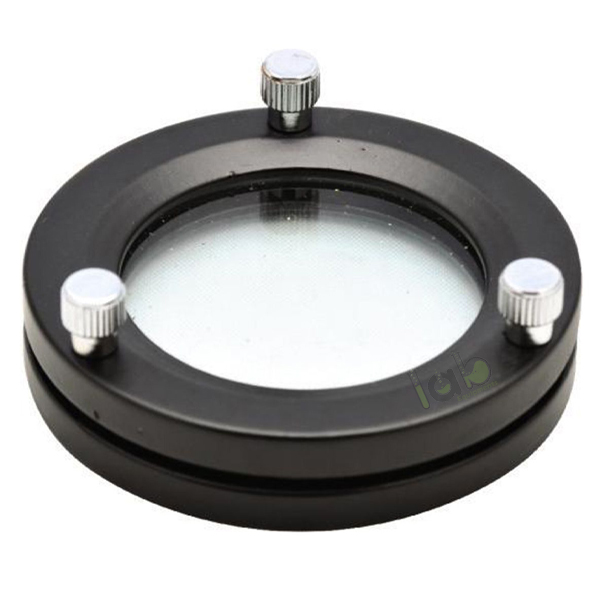
Quick answer: The Newton's Ring Apparatus produces the circular interference fringes known as Newton's rings, used to find the wavelength of monochromatic light or the radius of curvature of a lens. A plano-convex lens rests on a flat glass plate in a plastic frame, and three thumbscrews set the contact pressure. Lab Exports manufactures it in Delhi for schools, colleges and universities.
Specifications
| Component | Specification |
|---|---|
| Lens | Plano-convex |
| Plate | Flat glass |
| Frame | Plastic, holding the lens and plate together |
| Adjustment | Three thumbscrews controlling pressure between lens and plate |
The listing covers the lens-and-plate assembly; the light source and measuring microscope used in the full experiment are separate items.
How the Newton's rings experiment is done
When the curved face of a plano-convex lens rests on a flat glass plate, a thin wedge of air forms between them, zero at the point of contact and growing outwards. Light reflected from the top and bottom of this air film interferes, and because the film thickness is constant along circles around the contact point, the fringes appear as concentric bright and dark rings.
For the n-th dark ring seen in reflected light, r^2 = n x lambda x R, where r is the ring radius, lambda the wavelength and R the radius of curvature of the lens face. Measuring the diameters D of two rings n and n+m gives lambda = (D(n+m)^2 - D(n)^2) / (4 m R), or R when lambda is known.
- Set the thumbscrews so the lens just touches the plate and the rings are centred and circular.
- Illuminate the assembly with monochromatic light, such as a sodium lamp, reflected down onto it by a glass plate at 45 degrees.
- View the rings through a travelling microscope and focus on the dark central spot.
- Record the microscope readings on both sides of several rings and work out their diameters.
- Plot D^2 against ring number; the slope gives 4 lambda R.
Over-tightening the thumbscrews distorts the rings, so light pressure gives the best pattern. In white light the rings appear coloured, which also makes the frame a quick demonstration of thin-film interference.
Key features
- Plano-convex lens and flat glass plate assembled as one unit.
- Three thumbscrews for fine control of lens-to-plate contact pressure.
- Plastic frame holds the lens and plate together in alignment.
- Suited to wavelength and radius-of-curvature determinations.
- Also serves as a demonstration of thin-film interference colours.
Documentation and supply
Installation instructions and a manual are supplied with the apparatus. Most Lab Exports products carry a one-year manufacturer warranty.
Lab Exports manufactures the Newton's ring apparatus at its works in Laxmi Nagar, Delhi, and supplies it to schools, colleges and universities in India and 60+ countries, handling the export documents for each shipment. More about the company is on the About Lab Exports page.
Related Light and Optics products
- Plastic Mirror (EL-LAO-10349)
- Prism Microscope (EL-LAO-10351)
- Single Lens Eye Loupe (EL-LAO-10348)
- Tripod Magnifier (EL-LAO-10352)
- Glass Lens Demonstration (EL-LAO-10347)
- Polaroid Disc Mounted (EL-LAO-10353)
The full range is in the Light and Optics section of the Physics Lab range.
Frequently asked questions
What is the Newton's ring apparatus used to find?
It is used to determine the wavelength of monochromatic light, or the radius of curvature of the lens face when the wavelength is known, from the diameters of the interference rings.
Why does the apparatus have three thumbscrews?
The thumbscrews adjust the pressure between the lens and the glass plate so the point of contact is centred and the rings are clear and circular.
Why is the centre of Newton's rings dark in reflected light?
At the contact point the air film has zero thickness, and the half-wavelength phase change on reflection at the glass plate makes the two reflected beams cancel.
What is the price of the Newton's ring apparatus?
Prices are not published on the website. Add the Newton's ring apparatus to the Enquiry Cart with the Add To Cart button on this page, or email [email protected] with the house code EL-LAO-10350 and the quantity, to receive a quotation.
Does Lab Exports manufacture the Newton's ring apparatus?
Yes. Lab Exports manufactures the Newton's ring apparatus at its works at 11/315, Lalita Park, Laxmi Nagar, Delhi 110092, under house code EL-LAO-10350.
Request a quote
Email [email protected] with the house code EL-LAO-10350 and the quantity, or add the Newton's ring apparatus to the Enquiry Cart with the Add To Cart button on this page. Tender buyers can also see the Tenders and OEM page.