Hollow Glass Prism
Product Code : EL-LAO-10337
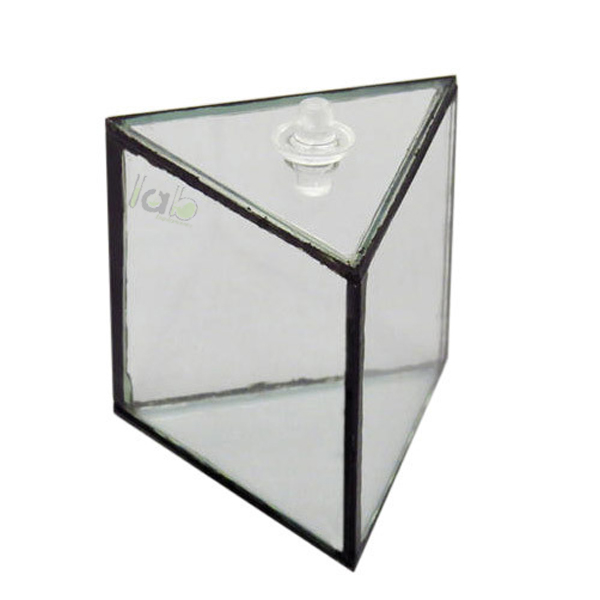
This hollow glass prism is built from plane plates of ordinary plate glass. Filled with a liquid on a spectrometer table, it gives the refractive index of that liquid from its angle of minimum deviation. It is made in 25, 38 and 50 mm sizes and packed in a velvet-lined case.
Specifications of the hollow glass prism
| Component | Specification |
|---|---|
| Material | Ordinary plate glass |
| Construction | Plane plates forming a hollow prism |
| Use | Spectrometer work, refractive index of liquids |
| Sizes | 25 × 25 × 25 mm, 38 × 38 × 38 mm, 50 × 50 × 50 mm |
| Packing | Velvet-lined case |
| House code | EL-LAO-10337 |
| Manufacturer | Lab Exports, Delhi |
Experiments with the hollow prism
The thin glass walls hardly deviate light themselves, so the deviation measured comes from the liquid inside. At minimum deviation, μ = sin((A + Dm)/2) / sin(A/2). Here μ is the refractive index of the liquid and Dm the angle of minimum deviation. A is the angle of the prism, between its two refracting faces.
- Refractive index of water. Fill the prism with water and set it on the prism table of a spectrometer lit by a sodium lamp. Measure A and Dm, then calculate μ.
- Comparing liquids. Empty, clean and dry the prism, then refill it with another liquid, such as turpentine. A glass dropper helps top it up without wetting the outer faces. Compare the values of μ for the two liquids.
- Liquid against glass. Repeat the measurement with a solid spectrometer prism on the same table. This gives the refractive index of glass for comparison with the liquids.
Spectrometer set-up and readings
- Level the spectrometer, focus the telescope and collimator, and set a narrow slit lit by the sodium lamp.
- Fill the hollow prism with the liquid and place it on the prism table.
- Measure the angle A from the images reflected by its two refracting faces.
- Turn the table slowly while following the refracted image. Note the position where the image stops and turns back, and read Dm there.
- After use, empty and clean the prism and store it in its velvet-lined case.
Frequently Asked Questions
Does an empty hollow prism deviate or split light?
Hardly at all. Each glass wall has parallel faces, so it only shifts a ray slightly sideways. With air inside, there is no wedge of denser material, so there is no deviation and no spectrum. That is why the deviation seen with a liquid inside is due to the liquid.
Why is the reading taken at the angle of minimum deviation?
At minimum deviation the ray crosses the liquid parallel to the base, and the angles of incidence and emergence are equal. Only then does the simple formula for μ hold. The minimum is also a turning point, so a small error in setting the table hardly changes Dm.
Why is a sodium lamp used instead of white light?
The refractive index, and so the minimum deviation, changes with the colour of light. A sodium lamp gives almost a single yellow colour, so there is one sharp image to set the cross-wire on. White light would spread into a short spectrum instead.
Does a liquid with a higher refractive index give a larger minimum deviation?
Yes. In the same prism, with the same angle A, a liquid that bends light more gives a larger Dm. Turpentine has a higher refractive index than water, so it shows a larger angle of minimum deviation in this prism.
Which size of hollow prism should be chosen?
The prism is made in 25, 38 and 50 mm sizes. A larger prism presents a wider face to the beam from the collimator, so the image is brighter, but it needs more liquid. Choose a size that sits fully on the prism table of your spectrometer.
Other prisms for optics practicals
More apparatus is in the Light and Optics section of the Physics Lab range.
To enquire, email [email protected] with the house code EL-LAO-10337 and the quantity, or use the Add To Cart button on this page.
Last updated: 19 November 2026