Resonance Apparatus
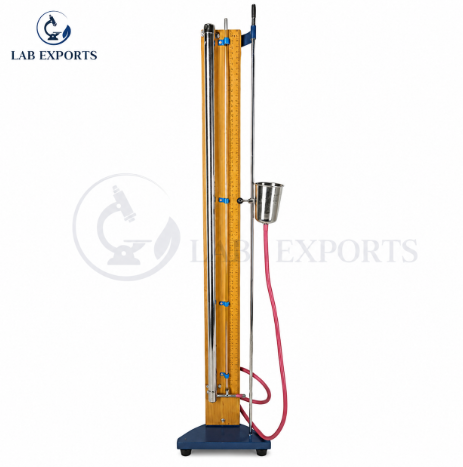
Product Code : SCL-PMP-11143
This resonance apparatus sets up acoustic resonance in an air column closed at one end. A sound source, such as a suitable tuning fork, is held over the open end while the column length is changed. The note becomes clearly louder at the resonance positions, which give the wavelength and the speed of sound.
Specifications of the resonance apparatus
| Component | Specification |
|---|---|
| Principle | Acoustic resonance of an air column |
| Concepts | Resonance, standing waves, frequency, wavelength, natural frequency and sound propagation |
| Sound source | A suitable tuning fork or other specified source |
| Accessories | Tuning fork, striker, reservoir, scale and stand confirmed with the quotation; not assumed to be included |
| House code | SCL-PMP-11143 |
| Manufacturer | Lab Exports, Delhi |
Speed of sound and end correction
The air column resonates when its effective length is an odd number of quarter wavelengths. The antinode forms a little beyond the open end, so a short end correction e is added to each measured length. Let l1 and l2 be the first and second resonance lengths, λ the wavelength and f the frequency of the source. Then:
- l1 + e = λ/4 and l2 + e = 3λ/4.
- Subtracting removes e, so λ = 2(l2 - l1) and the speed of sound v = 2f(l2 - l1).
- Clamp the tube upright with a retort clamp with bosshead. Where a water reservoir is used, join it to the tube with rubber tubing and check that the joint does not leak.
- Strike a fork of known frequency gently and hold it just above the open end with its prongs vertical.
- Lengthen the air column slowly from its shortest setting. Note the length l1 where the sound is loudest, then go on to the second loud position l2.
- Repeat each reading with a freshly struck fork, approaching from above and below, and take the mean. Note the room temperature, since sound travels faster in warmer air.
- Measure the inner diameter of the tube with a vernier caliper, because the end correction depends on the tube radius.
Frequently Asked Questions
What should a buyer look for in a resonance tube apparatus?
A tube of uniform bore and a clear scale lined up with it come first. The column length should change smoothly, and the stand should hold the tube steady and upright.
Is a tuning fork included with the resonance apparatus?
It is not assumed. The tuning fork, striker, reservoir, scale and stand are all confirmed with the quotation. State the fork frequencies you need, and whether a striker is wanted, when you send the enquiry.
Why are two resonance lengths measured instead of one?
Because the end correction is not known exactly. Each length includes the same unknown e, so taking the difference l2 - l1 cancels it. That difference is half a wavelength, which gives v without needing e.
What is the formula for end correction in a resonance tube experiment?
From the two resonance conditions, e = (l2 - 3l1)/2, where l1 and l2 are the first and second resonance lengths. The end correction depends on the radius of the tube, so a wider tube gives a larger e.
What are the sources of error in a resonance tube experiment?
The main ones are judging the loudest point by ear, a tube of uneven bore, a fork held at a varying height or angle, and parallax when reading the scale. A change in room temperature also changes the speed of sound. Repeated readings from both directions reduce the error.
Other apparatus for standing waves
More apparatus is in the Physics Miscellaneous Products section of the Physics Lab range.
To enquire, email [email protected] with the house code SCL-PMP-11143 and the quantity, or use the Add To Cart button on this page. Tender buyers can also see the Tenders and OEM page.
Last updated: 28 November 2026