Hofmann Voltameter
Product Code : EL-E-10975
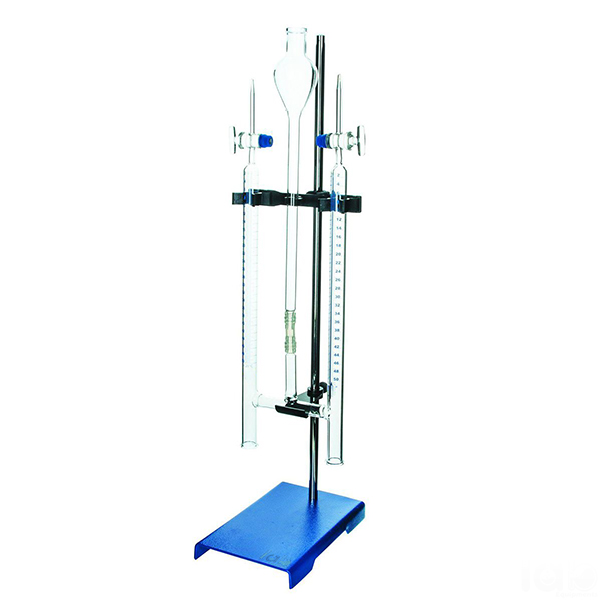
The Hofmann voltameter, also spelt Hoffman voltameter, electrolyses water and collects the two gases separately. Three parallel glass tubes are joined at the base. The two side tubes are graduated 0 to 50 mL in 0.2 mL divisions and end in stopcocked jets. The centre tube carries a filling funnel.
Specifications of the Hofmann voltameter
| Component | Specification |
|---|---|
| Construction | Three parallel glass tubes joined by a horizontal tube |
| Side tubes | Graduated 0 to 50 mL × 0.2 mL |
| Filling | Funnel on the central tube |
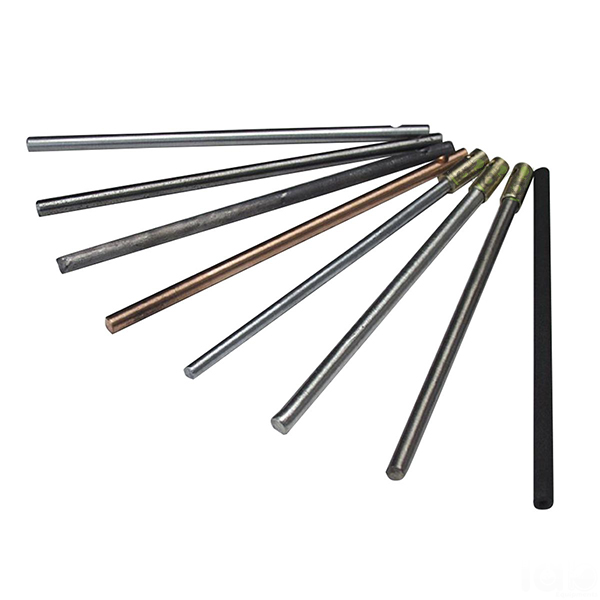
| Electrode fitting | Open lower ends of the side tubes take bungs holding the electrodes |
| Gas outlets | Jet with a stopcock on each side tube |
| Mounting | Clamps and support base recommended, sold separately |
| House code | EL-E-10975 |
| Manufacturer | Lab Exports, Delhi |
Electrolysis practicals with the Hofmann voltameter
A direct current splits water, made conducting with a little dilute sulphuric acid, into hydrogen and oxygen. At the cathode, 4H+ + 4e- → 2H2. At the anode, 2H2O → O2 + 4H+ + 4e-.
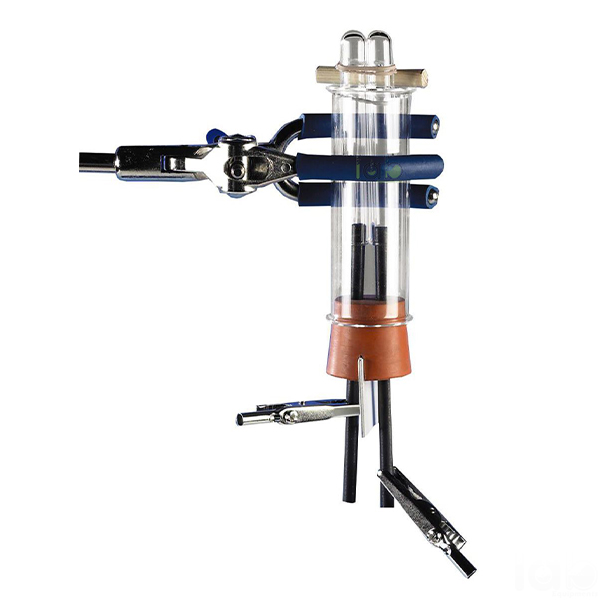
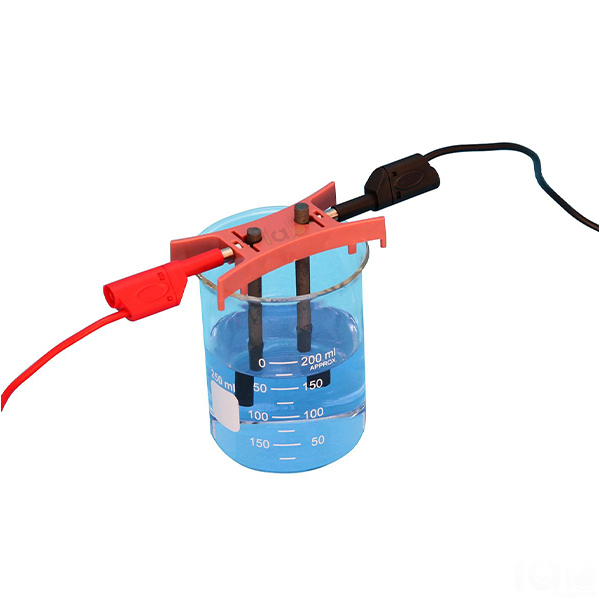
- Composition of water by volume. Clamp the voltameter upright with a retort clamp with bosshead and run it from a battery eliminator on low-voltage DC. Read both side tubes at intervals. The cathode tube collects twice the volume of the anode tube, matching the formula H2O.
- Testing the gases. Open one stopcock at a time and let a little gas out through its jet. Hydrogen burns with a squeaky pop at a lighted splint. Oxygen relights a glowing splint.
- Laws of electrolysis. Put an ammeter in the circuit and record the current I and the time t. The charge passed is Q = It, and the moles of hydrogen formed are Q/(2F), where F is the Faraday constant. Compare this with the volume read on the cathode tube.
Setting up and filling
- Mount the voltameter in clamps on a support base. Fit the electrodes, in their bungs, into the lower ends of the side tubes.
- Open both stopcocks and pour dilute acid into the central funnel until both side tubes are full. Then close the stopcocks.
- Connect the electrodes to the low-voltage DC supply and switch on.
- Read the gas volumes against the 0.2 mL graduations, with your eye level with the liquid surface.
Documentation and supply
Installation instructions and a manual are supplied with the apparatus. Most Lab Exports products carry a one-year manufacturer warranty.
Lab Exports manufactures the Hofmann voltameter at its works in Laxmi Nagar, Delhi, and supplies it to schools, colleges and universities in India and 60+ countries, handling the export documents for each shipment. More about the company is on the About Lab Exports page.
Frequently Asked Questions
Why is dilute sulphuric acid added to the water?
Pure water conducts electricity very poorly, so almost no current flows. A little dilute sulphuric acid supplies ions that carry the current. The acid is not used up. Water is split into its elements, and the sulphate ions stay in the solution.
Why is more hydrogen collected than oxygen?
Each water molecule holds two hydrogen atoms for one oxygen atom. The same four electrons release two molecules of hydrogen at the cathode but only one molecule of oxygen at the anode. Equal numbers of gas molecules fill equal volumes at the same temperature and pressure, so the volumes come out 2:1.
Which gas collects at which electrode?
Hydrogen collects over the cathode, which is the electrode joined to the negative terminal of the supply. Oxygen collects over the anode, joined to the positive terminal. The tube with the larger volume of gas is therefore the cathode side.
Should platinum or carbon electrodes be used?
Platinum does not react, so it gives volumes closest to 2:1. Carbon can be used, but at the anode some oxygen reacts with the carbon to form carbon dioxide, which partly dissolves. The oxygen volume then reads low, and the carbon rod slowly wears away.
Is a stand supplied with the Hofmann voltameter?
No. Clamps and a support base are recommended and are sold separately. Clamp the glass firmly but gently, upright, so that the side tubes can be read at eye level.
What safety precautions are needed for this experiment?
Wear safety goggles, because the electrolyte is a dilute acid. Use only a low-voltage DC supply. Test only a small amount of each gas at a time. Never let hydrogen and oxygen mix in one vessel, because the mixture explodes when lit.
Other electrolysis apparatus
More apparatus is in the Electrolysis section of the Chemistry Lab range.
To enquire, email [email protected] with the house code EL-E-10975 and the quantity, or use the Add To Cart button on this page. Tender buyers can also see the Tenders and OEM page.
Last updated: 19 November 2026